Publishing
How to Review an AI Rewrite Before Using It
Compare facts, scope, tone, and commitments so a fluent rewrite does not silently change the message.
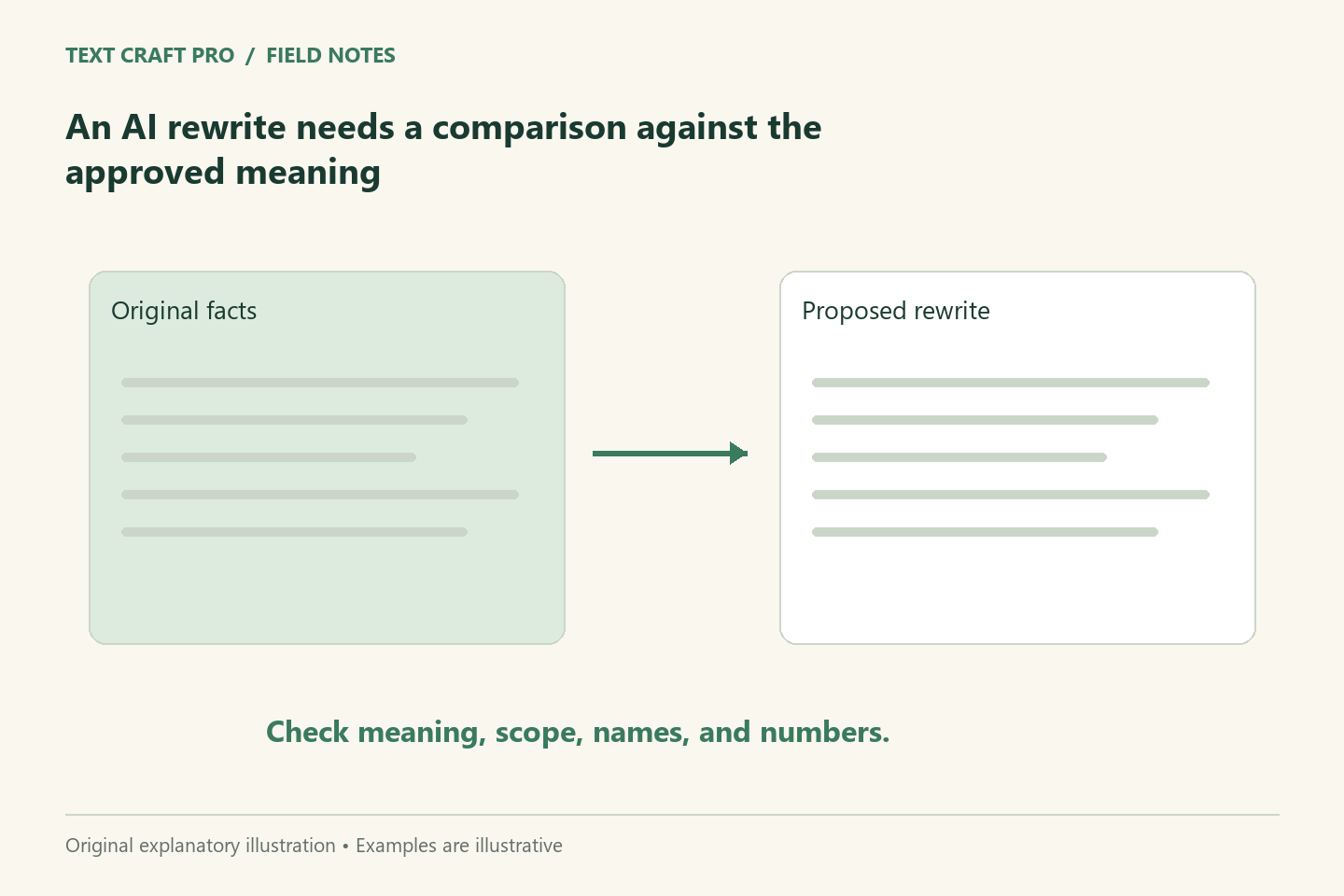
An AI rewrite can make a draft sound polished while changing an important detail. It may remove a condition, add a promise, or replace a precise term with an inaccurate synonym. Treat the output as a proposed revision. The review should compare it with approved meaning and evidence rather than judging only whether the new version reads smoothly.
Keep the original and the instruction
Save the source draft beside the rewrite and record what you asked to change. A request to shorten the text is different from a request to change its audience or format. State which facts and commitments must remain fixed. If the source contains private information, use only the data appropriate for the approved service and task. Do not assume that a convenient editing feature is an approved destination for every record.
Compare the factual content first
Check names, numbers, dates, quotations, limitations, and causal claims. Look for facts that appear only in the rewrite. A model may add plausible context even when the instruction asks it not to invent details. Missing uncertainty can be as important as a new claim. If the original said a result might happen, a version saying it will happen has changed the meaning.
Check responsibility and commitments
Review words such as must, may, can, will, and should. They affect whether a sentence describes an option, requirement, or promise. Confirm the actor and the approval path. A friendlier message should not imply a guaranteed response time that the business has not approved. Ask the responsible person to resolve ambiguities instead of accepting the most fluent version as an operational decision.
Review style after meaning
Once the facts are stable, assess clarity, tone, terminology, and structure. Preserve useful distinctions rather than removing every repeated term. Check whether the output still serves the intended reader. An expanded rewrite can introduce generic advice that dilutes the central task. A shortened rewrite can omit the example that made the method usable. Style improvement must be assessed in the context of the whole piece.
Use a fictional comparison
Original: “We can review the outline after the project owner confirms the missing details.” Rewrite: “We will approve your outline today.” The rewrite changes review to approval, removes the dependency, and adds a deadline. A safer proposal might be: “Once the project owner confirms the missing details, we can review the outline.” That version improves the order while preserving the limitation.
Approve the saved result separately
Do not treat generating a rewrite as permission to publish or send it. Save a draft, review the actual page or message, and have the appropriate owner approve consequential commitments. Keep a note of unresolved facts and the checks actually performed. The brief builder can help organize constraints, but it cannot verify whether a model obeyed them. That requires comparison with the result.
Frequently asked questions
Can I rely on the instruction “do not change facts”?
It is a useful constraint, not a guarantee. Compare the output with the source and approved references.
Is a grammar correction safer than a full rewrite?
A smaller change can be easier to review, but it can still alter meaning. Check the specific revision rather than assuming a category is risk-free.
Continue your workflow
- How to Change the Tone of a Message Without Changing Its Facts
- How to Check Sources and Claims in a Draft Article
Was this guide helpful?
Tell us what needs improving →
Your selection stays on this page. To send feedback to the publication, use our contact form.
Published 30 September 2026 · Text Craft Pro · AI-assisted educational writing. Editorial policy · Suggest a correction