Publishing
How to Check Sources and Claims in a Draft Article
Build a claim list, read the supporting material, and distinguish facts, interpretations, and fictional examples.
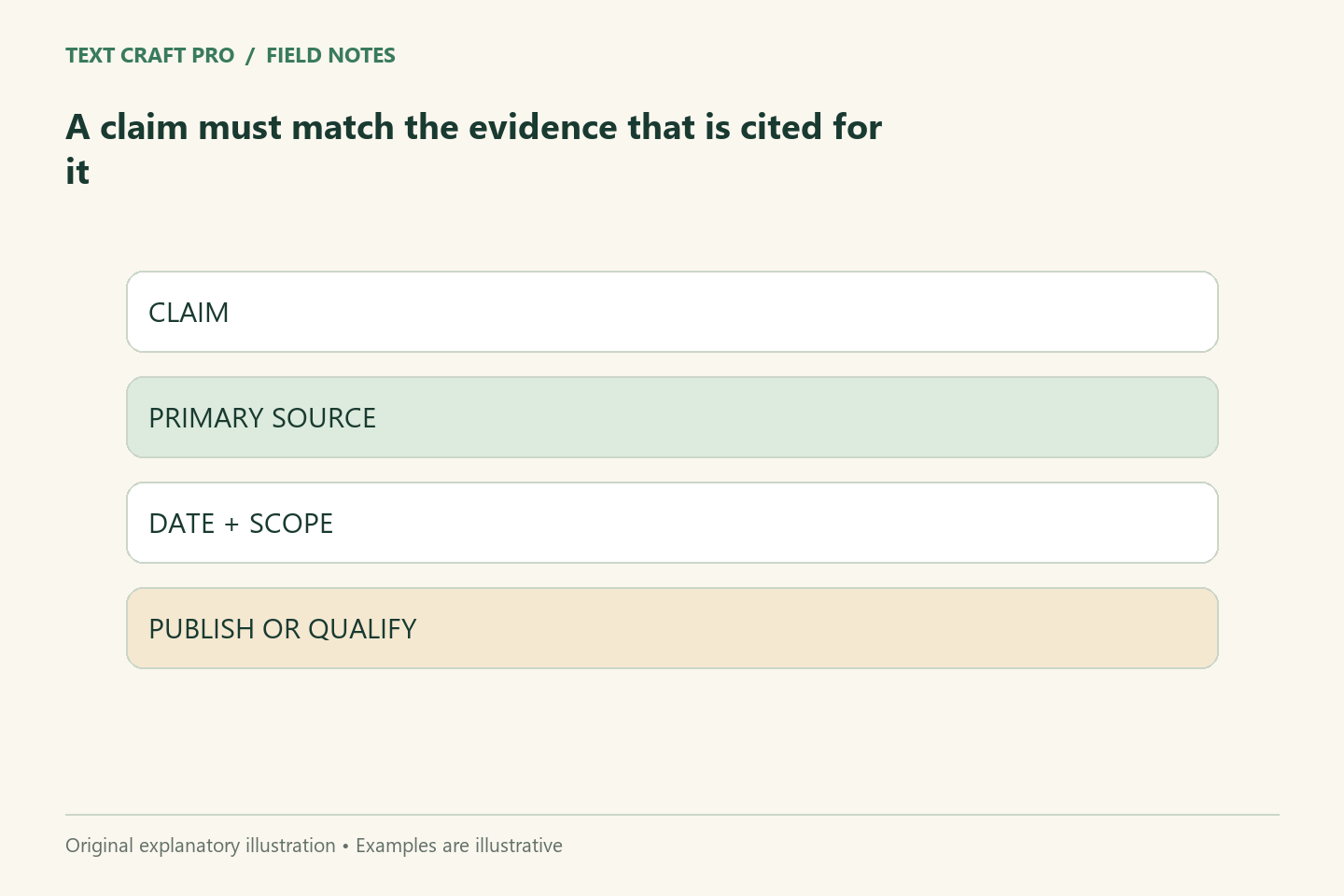
A source link is useful only when it supports the claim beside it. A draft can contain real links and still misrepresent what those pages establish. Checking sources means reading the relevant material, comparing it with the claim, and preserving its scope and limitations. It also means recognizing which parts of an article are original explanation, inference, or fictional illustration.
List claims that need evidence
Mark factual statements about products, policies, statistics, dates, or documented outcomes. General writing examples may not need external evidence, but claims about an observed result do. Separate your own proposed method from statements about what another organization recommends. This prevents a citation from appearing to endorse an entire article when it only supports one specific point.
Read the supporting material
Open the actual source rather than relying on a search snippet or another article’s summary. Find the passage that supports the claim and note relevant conditions. Prefer the organization’s own documentation for product behavior and policy. Check whether the page is current for the statement you plan to make. If it is a historical source, identify that context instead of presenting it as an up-to-date instruction.
Match strength to evidence
A source describing a possible use does not prove that use improves results in every situation. A small test does not establish a universal outcome. Keep uncertainty and limitations in the wording. If a claim goes beyond the source, narrow it or label your inference. Removing a strong claim can improve an article more than adding an unrelated link to make it look researched.
Distinguish examples from actual results
A fictional example can explain a method without claiming that a customer used it. Label it clearly and use realistic assumptions. If you report actual testing, state what was tested, how, and what the result can support. Do not borrow someone else’s test and write it as your own experience. A publisher should be able to identify the evidence behind each claimed observation.
Use a simple claim record
For a fictional article, the record might contain: claim; source; relevant passage; publication or access context; reviewer decision. A statement about how Google chooses snippets can link to Google’s current documentation. A statement about a fictional subject-line revision should identify it as an example, not a measured campaign result. The record can remain internal while the article supplies useful citations where readers need them.
Resolve gaps before publication
If a source cannot be found or does not support the claim, revise the passage. Do not leave a citation placeholder in a published article. Use an honest limitation when evidence is unavailable, and keep the remaining explanation useful. After changes, check links and wording in the saved page. Source checking is a specific review process; avoid claiming it happened when only a list of links was generated.
Frequently asked questions
Does every sentence need a citation?
No. Cite claims that depend on external evidence or attribution. Original explanation and clearly fictional examples can be identified without attaching an unrelated source.
Can I cite a source I have not read?
Read the relevant supporting material before presenting it as evidence. A link alone does not establish what it supports.
Continue your workflow
- How to Build an Original Article From Research Without Copying Its Structure
- A Pre-Publication Checklist for a Useful, Trustworthy Article
Was this guide helpful?
Tell us what needs improving →
Your selection stays on this page. To send feedback to the publication, use our contact form.
Published 2 October 2026 · Text Craft Pro · AI-assisted educational writing. Editorial policy · Suggest a correction