Publishing
A Pre-Publication Checklist for a Useful, Trustworthy Article
Review reader value, facts, original examples, images, links, metadata, and the actual saved page before publishing.
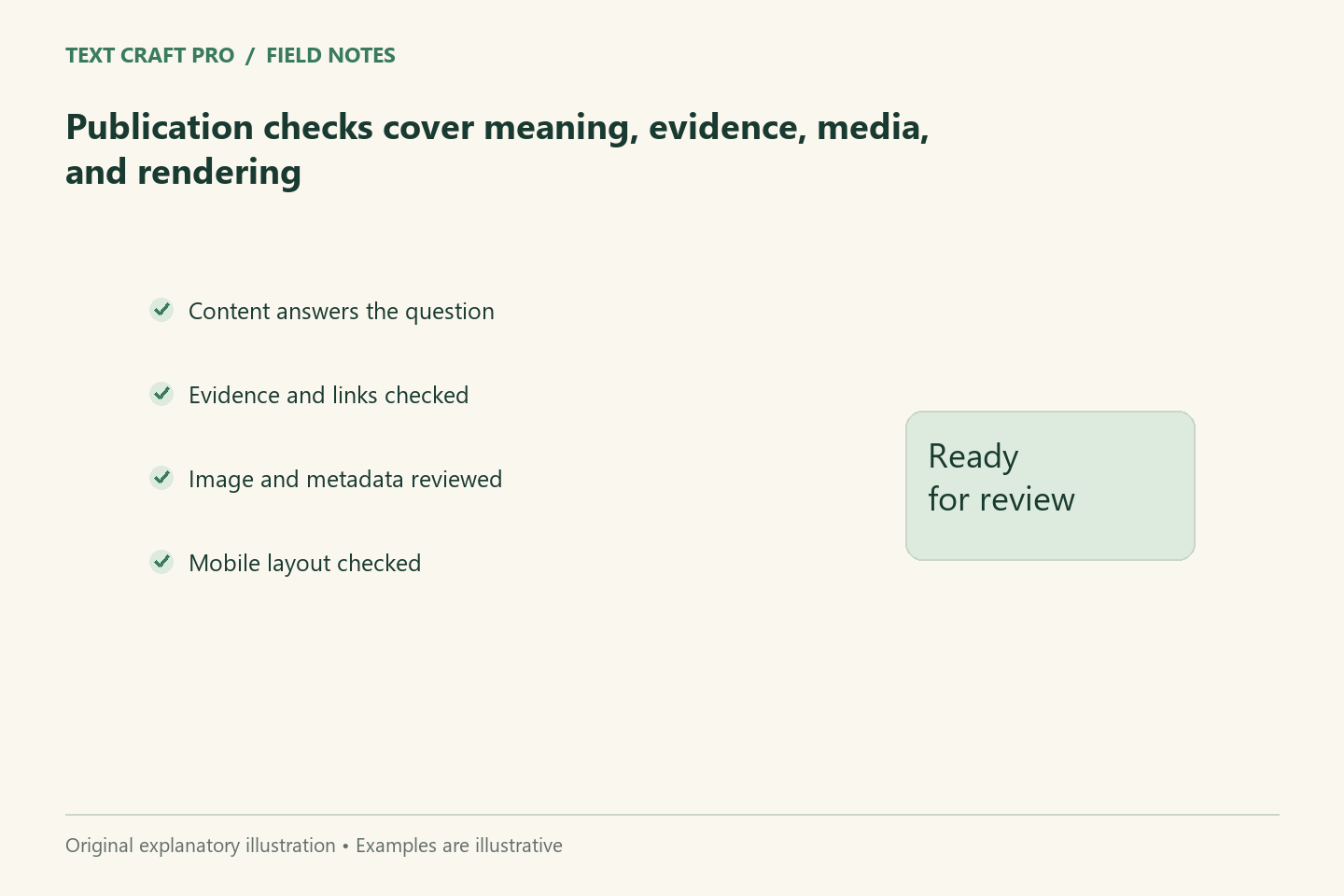
A publication checklist should help a publisher make a review decision, not merely confirm that fields are filled. A page can have a title, image, and description while still failing to answer its question. Start with reader value and evidence, then inspect the presentation and saved result. Keep the checklist tied to checks that can actually be performed.
Confirm the central answer
Compare the article with its brief. Does it answer the promised question? Can the intended reader apply the explanation, and are necessary prerequisites included or linked? Remove repeated sections that do not add a new distinction. Check that the title and introduction reflect the finished scope. A useful answer to one defined task is stronger than a broad promise supported by generic paragraphs.
Review facts and examples
Check claims against relevant sources and approved material. Label fictional examples and describe the limits of actual tests. Resolve placeholders and unsupported assertions before publication. Verify calculations and conditions. Do not present an AI-generated draft as fact-checked merely because it contains source links. The review needs to compare the claims with what those sources actually establish.
Inspect media and attribution
Confirm that each image belongs to the article and has an appropriate source or permission. Use topic-specific alternatives and honest captions. A diagram should not be described as a product screenshot. Check quotations and source labels. The page should not contain invented author identities, credentials, testimonials, or customer logos. Professional presentation depends on accurate identity as well as attractive layout.
Check links, tools, and metadata
Open relevant links and test section anchors. Test interactive tools with ordinary and invalid inputs, keeping claims limited to the cases checked. Review the page title, description, canonical URL, and indexability in the actual output. Metadata should describe the article rather than add promises absent from its body. Confirm that a draft has not been published unintentionally through an automated workflow.
Preview the reader experience
Check a desktop and narrow-screen layout. Review heading structure, image size, table overflow, contrast, form labels, and the footer. A correct source can still render incorrectly after an editor or theme changes it. Check cookie and privacy behavior for services actually enabled. A policy page is not a substitute for implementing the controls it describes.
Record the publisher’s decision
Keep a brief note of substantive checks, unresolved limitations, and the approving role. If a required fact remains unresolved, hold the page or narrow the claim rather than publishing a confident placeholder. After publication, verify the public URL and keep a correction route available. This checklist organizes responsibility; it does not guarantee rankings, advertising approval, or a permanently error-free page.
Frequently asked questions
Does a complete checklist guarantee AdSense approval?
No. Advertising approval depends on Google’s review and current policies. A checklist helps improve the publication but cannot decide that outcome.
Should I request indexing before reviewing the page?
Review and publish the intended result first. A sitemap can then help search engines discover the public page, without guaranteeing indexing.
Continue your workflow
- A Proofreading Checklist for Articles, Emails, and Web Pages
- How to Maintain a Guide Library After Publication
Was this guide helpful?
Tell us what needs improving →
Your selection stays on this page. To send feedback to the publication, use our contact form.
Published 8 October 2026 · Text Craft Pro · AI-assisted educational writing. Editorial policy · Suggest a correction