Web Content
How to Write a Headline That Makes an Accurate Promise
Match the headline to the reader’s question, the article’s evidence, and the actual answer rather than relying on exaggerated claims.
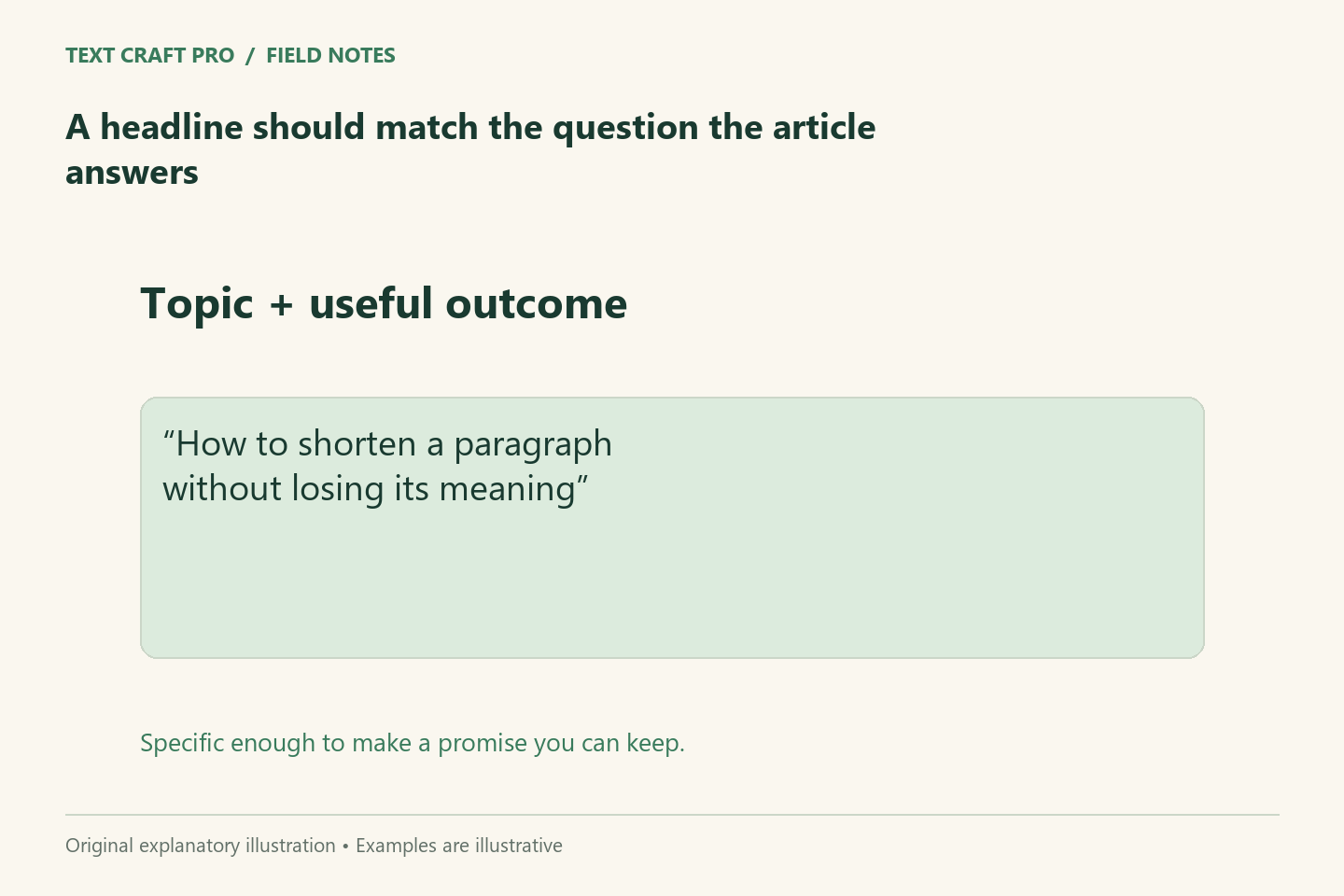
A headline sets an expectation before a reader sees the body. It should describe the article’s central task and give a useful reason to open it. That promise needs to survive the reading experience. A dramatic headline may attract attention, but it creates a mismatch if the article only offers a general explanation or cannot support its strongest claim.
Write the answer before the headline
Summarize what the finished article actually explains. Identify the reader and the result they can reasonably achieve. “Prepare a content brief” is a concrete task; “master all content strategy” is a much broader promise. If the article does not yet have a clear answer, fix the scope before polishing the headline. A precise title cannot make an unfocused body useful.
Choose a format that fits the task
A how-to headline fits instructions. A question headline fits a focused explanation. A checklist title fits a genuinely usable checklist. A comparison title needs actual criteria and evidence about the options. Do not label a general opinion as a tested review. The format should help readers recognize what kind of support the article offers.
Add meaningful specificity
Name the context or limitation that distinguishes the article. “A proofreading checklist for web pages” is more useful than “The ultimate proofreading guide” if the article focuses on saved-page checks. Avoid stuffing several audiences or related keywords into one title. Specificity comes from a defined problem, not from increasing the number of terms that could match a search.
Remove unsupported superlatives
Words such as best, perfect, guaranteed, and ultimate can imply evidence or completeness that the article lacks. A comparison can explain its criteria and limits instead of claiming universal superiority. A tutorial can describe the actual method. If a number appears in the headline, confirm that the numbered items correspond to meaningful parts of the article rather than splitting one idea to inflate the count.
Compare fictional alternatives
For an article about editing requests, consider “The Best Email Secret,” “Write Better Emails,” and “How to Ask for Draft Feedback With a Clear Next Step.” The third title names a specific task that the body can demonstrate. It will not serve every email question, and that is acceptable. The title’s value is that the intended reader can recognize the promised help.
Review the title after editing
A draft can change scope as evidence and examples improve. Recheck the title after structural revisions. Compare it with the introduction, headings, and conclusion. Our title-preview tool displays your wording at illustrative widths, but it cannot predict the exact title or layout a search engine will show. Use it to inspect clarity and likely truncation, then make a judgment based on meaning.
Frequently asked questions
Does a headline need a number?
No. Use a number when it accurately describes a meaningful list. A clear task or question can be sufficient.
Can I promise rankings in the headline?
Only claims supported by appropriate evidence belong in content. A headline technique cannot guarantee rankings for an individual page.
Continue your workflow
- How to Identify Reader Intent Before Choosing an Article Angle
- How to Write a Page Title That Matches the Page’s Main Heading
Was this guide helpful?
Tell us what needs improving →
Your selection stays on this page. To send feedback to the publication, use our contact form.
Published 18 September 2026 · Text Craft Pro · AI-assisted educational writing. Editorial policy · Suggest a correction