Business Writing
How to Write a Service Page That Sets Scope and Expectations Clearly
A service page should answer who it helps, what is included, and what happens next. My plain method for writing one from approved facts, not promises.
 Written by Daniel Carter
Daniel Carter writes and edits practical guides on writing, editing, and publishing at Text Craft Pro, based on hands-on testing and documented examples.
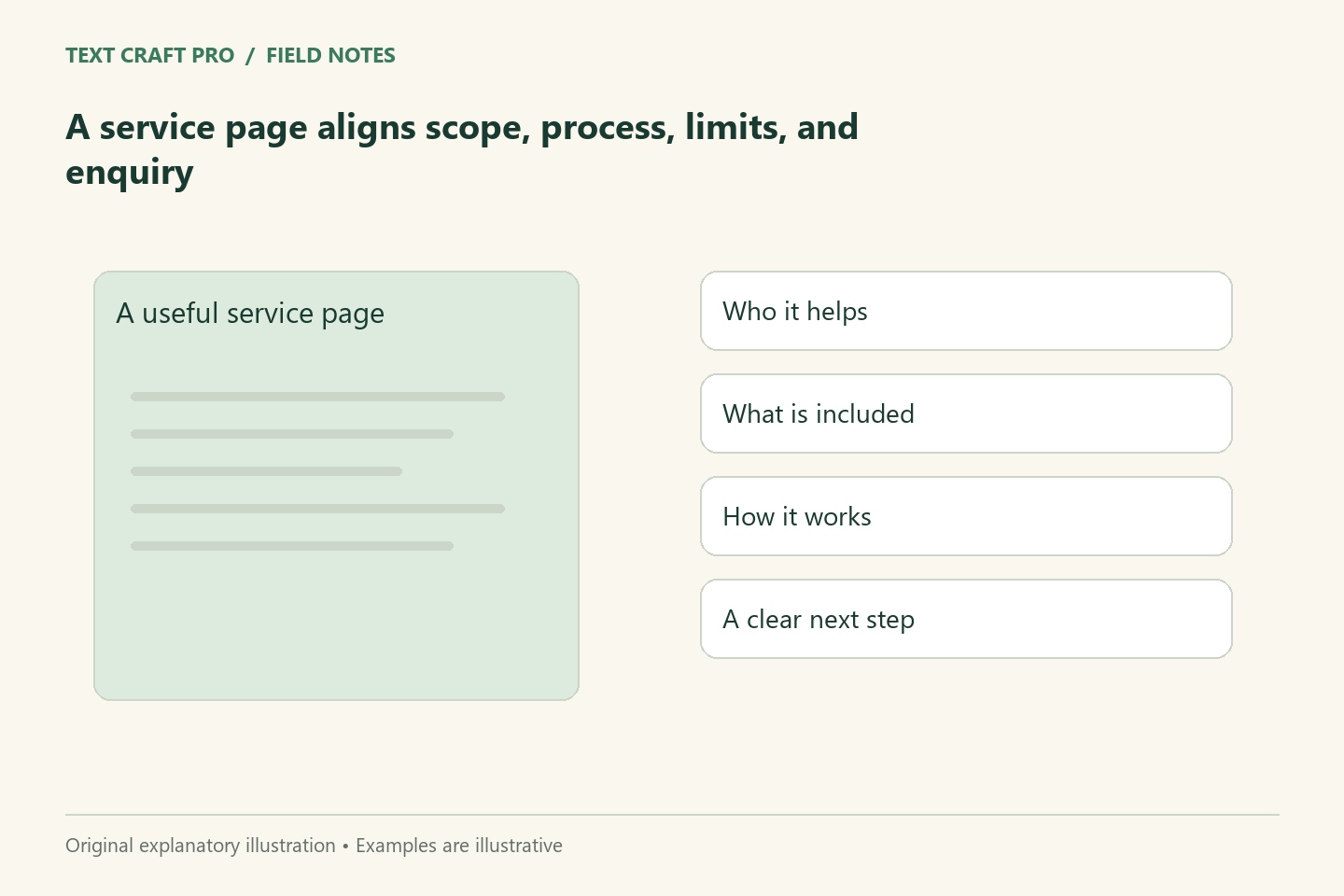
I write service pages the way I would want to read them as a customer: anxiously, with one question looping — “Yes, but what exactly do I get?” The weakest service pages I have edited all failed the same way. They described a feeling (“content support,” “a partner in your growth”) and left every practical question — what, when, how much input, what is excluded — for an enquiry call the reader never made.
So my rule: a service page is built from approved operational facts, organized around the customer’s decision. If a fact is not approved yet, the page does not get to invent it. Here is the order I work in.
Who is this service for — and who is it not for?
I open with the customer’s situation, in words they would use themselves, and I name the fit honestly. If the work only suits certain industries, sizes, or starting points, that goes on the page, early, where it saves everyone time. “For everyone who needs words” is not positioning; it is a shrug. When I test a draft, I ask whether a wrong-fit reader could tell within thirty seconds that this is not for them. A page that politely turns away the wrong enquiries earns better ones — and the reader who stays now trusts the rest of the page a little more.
What exactly is included, in plain deliverables?
Deliverables, counted and named. “Content support” becomes, if it is true, “an approved outline, one full draft, and one revision round.” Every service page I finish also carries the other list: what is excluded, and what the work depends on — the source material, access, or decisions the customer must supply. I am suspicious of tidy three-tier packages that exist because the template had three columns. If the tiers are not real, approved offerings, they do not go on the page, however symmetrical they look. The owner signs off on scope; my job is to make the signed-off scope impossible to misunderstand.
How does the work actually run, start to finish?
Stages, in order: enquiry, a scope conversation, collecting sources, the draft, one review, delivery. Beside the stages I say how timing is set — agreed per project after the scope is clear — and what commonly causes delays, because a page that names its delays reads as experienced, while a page promising a turnaround nobody confirmed reads as a trap. If there is no standard turnaround, I write exactly that. A customer can plan around honesty. What they cannot plan around is a cheerful estimate that quietly becomes a grievance in week three.
What evidence can a service page honestly show?
Whatever is documented and authorized — real examples, real results, described for what they actually show. And when that cupboard is bare, the page shows its working instead: the approach, the process, a labeled teaching example. What it never shows is set dressing: testimonials from no one, logos of clients who are not, a team that does not exist, years of experience counted creatively. I have read new businesses oversell their history and then spend the first call quietly renegotiating their own page. Your page should be the most conservative document you own.
Can we draft one fictional service, scope and all?
Here is a teaching example — not a service Text Craft Pro sells. The offer: a reviewed website introduction, written from approved company facts. Included: one short brief, an outline, a draft, and one agreed revision round. Excluded: legal review, translation, and any claim about search rankings or sales. Process: scope confirmed first, then sources collected, then the draft, the review, and delivery, with timing agreed before work starts. Notice what that paragraph lets a reader do: decide. They know what they would get, what they would not, and what happens after they ask. That is the entire job of the page, done in five sentences.
What should the enquiry step ask — and not ask?
The last block on the page is a call to action, and I hold it to the same standard as any other: the label says what happens — “Send an enquiry,” not “Book now,” unless booking is genuinely what the button does. The form asks only for what a scope conversation needs: who the audience is, what the page or document is for, what material already exists, and the timing they hope for. It does not ask for private records to look thorough. And before publishing, I read the page, the form, and the privacy policy side by side, because the customer will experience them as one promise — they should at least agree with each other.
What does a clear scope table look like?
After the deliverables section, I add one small table that does the work of three paragraphs. Three columns: what is included, what is excluded, and what the work depends on the customer to supply. Readers scan it in seconds, and it prevents the two most expensive misunderstandings I have seen — the customer who assumed something was included, and the supplier who assumed the customer would provide it. I write it from the approved scope, in the same words the rest of the page uses, so the table and the prose can never disagree with each other.
| Included | Excluded | Depends on the customer |
|---|---|---|
| An approved outline, one full draft, one revision round | Original research and interviews | Source material and brand notes before drafting starts |
| One 30-minute call to agree the brief | Rush delivery inside five working days | A named contact who can approve the draft |
| Delivery as an editable document | Publishing and formatting in the CMS | Access to the existing pages being rewritten |
The table is also a test of the page itself. If a row is hard to fill honestly, the scope is not settled yet, and the page should wait — a vague table is worse than no table, because it looks precise while saying nothing. When the scope is real, the table becomes the part of the page customers quote back to me in the enquiry, which is exactly what it is for. The enquiry step should then ask only for what the table needs: the material, the contact, and the decision — the same discipline as a call to action that names what happens next.
Frequently asked questions
Should I publish prices?
If approved prices and a fixed scope exist, yes — publishing them saves everyone a call. If every project differs, I explain how an estimate is prepared instead of inventing a standard package to fill the space.
Can a new site have a professional service page?
Absolutely. Professional means clear scope and honest identity, not a long history. A new business that says exactly what it does, and declines to claim what it has not done, reads as more credible than a padded page — because it is.
How long should a service page be?
Long enough to settle scope, process, evidence, and the enquiry — usually 1,200 to 2,000 words for a real service. Shorter than that, and the reader has to ask the questions the page should have answered. Longer, and the page is usually repeating itself or selling instead of explaining.
Should I name a price or a price range?
Only if the price is approved and stable. A named range that is really a guess will be quoted back to you, and a page that says “prices from” without saying from what is just a prettier way of hiding. If pricing genuinely depends on scope, say that plainly and say what the first step costs: usually the call, which should be free.
What if the service changes often?
Write the page around the parts that do not change — who it is for, how the work runs, what a good result looks like — and keep the changeable details (prices, turnaround, availability) in the one table that is easy to update. A page that needs a rewrite every month is a page built on the wrong facts.
Continue your workflow
- How to Write a Call to Action That Tells Readers Exactly What Happens Next
- How to Write a Content Brief That Gives a Writer a Clear Starting Point
Was this guide helpful?
Tell us what needs improving →
Your selection stays on this page. To send feedback to the publication, use our contact form.
Published 16 September 2026 · Text Craft Pro · AI-assisted educational writing. Editorial policy · Suggest a correction