Editing
How to Fact-Check AI-Generated Drafts
AI drafts sound certain about everything, including the things they invented. Here’s the routine I use to catch the invented parts before your readers do.
 Written by Daniel Carter
Daniel Carter writes and edits practical guides on writing, editing, and publishing at Text Craft Pro, based on hands-on testing and documented examples.
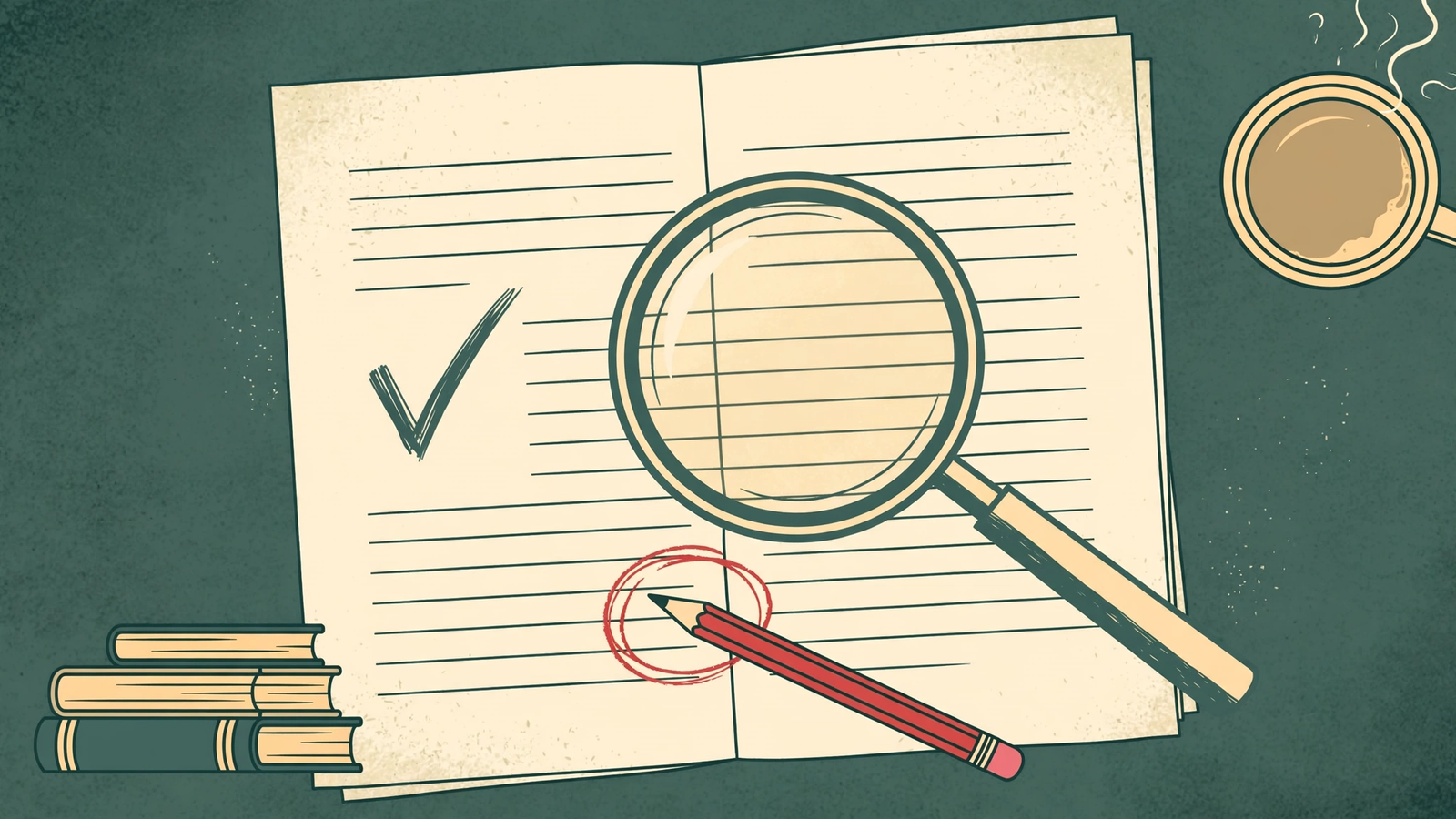
AI drafts never sound unsure. That’s the problem. A model can hand you a wrong date, a made-up statistic, and a quote nobody ever said — all in the same calm, confident voice it uses for the things it got right. If you publish that draft without checking it, your readers won’t blame the tool. They’ll blame you.
I’ve caught AI drafts inventing sources, misquoting real people, and stating last year’s prices as today’s. None of it looked wrong. That’s what makes fact-checking AI output a different skill from fact-checking a human: you’re not hunting for typos or sloppy reasoning. You’re hunting for confident fiction. Here’s the routine I use.
AI doesn’t lie — it guesses confidently
The first thing to get straight: an AI tool isn’t lying to you. Lying requires intent. What it does is predict the most plausible next sentence, and plausibility is not truth. A statistic that looks exactly like a real statistic — right format, right magnitude, right citation style — can be entirely invented. The model doesn’t know it’s inventing. It just knows the sentence sounds right.
That changes how you read. With a human draft, you check the claims that look shaky. With an AI draft, you check the claims that look smooth. The smoother and more specific a claim sounds — a precise percentage, a named study, a direct quote — the more suspicious you should be, because specificity is exactly what the model is best at faking.
My working rule: treat every factual claim in an AI draft as unverified until I check it myself. Not because the tool is useless — most of what it writes is fine — but because the errors are invisible. A draft that’s 90% correct and 10% invented reads exactly like a draft that’s 100% correct.
Sort claims into three buckets
You don’t need to verify everything with the same intensity. I sort every factual claim in a draft into three buckets before I start checking.
Bucket one: hard facts. Dates, numbers, prices, names, places, statistics, legal claims. These are either right or wrong, and they’re the ones that embarrass you when they’re wrong. Check all of them.
Bucket two: judgment calls. “This is the best tool for beginners.” “Most writers prefer X.” These are opinions dressed as facts. You don’t need a source for an opinion, but you do need to decide whether you actually agree with it — and rewrite it as your opinion if you do, instead of letting the draft present it as settled truth.
Bucket three: things that sound like facts but are actually vibes. “Studies show that readers prefer short paragraphs.” Which studies? There probably aren’t any. “Experts agree that…” Which experts? The model made them up. Anything with “studies show,” “research suggests,” or “experts say” and no named source goes straight into bucket one until proven otherwise — and most of the time, it fails the check and gets cut.
Sorting takes five minutes and it tells you where to spend your time. Skip it and you’ll waste an hour verifying opinions while a wrong date sails through.
Check the numbers first
Numbers are where AI drafts fail most often and most visibly. A wrong percentage in your article is the kind of mistake a reader screenshots. So I check numbers before anything else.
Start with the easy ones: any number you can verify in under a minute. Current prices, release dates, version numbers, population figures. Search for them directly — not through the AI tool, through an actual search engine, on a primary source if you can find one. A company’s own pricing page beats a blog post about its pricing. An official statistics page beats a news article quoting it.
Then the statistics with citations. When a draft says “a 2023 study found that 68% of readers skim articles,” I want three things: does the study exist, does it say 68%, and is it actually from 2023? I’ve seen drafts cite real studies with wrong numbers, wrong studies with right-sounding numbers, and studies that don’t exist at all. If I can’t find the study in two searches, the statistic comes out. No exceptions. A missing statistic is a small hole. A fake statistic is a credibility problem.
One more numbers habit: watch for suspicious precision. Real research rarely produces numbers like “73.4% of users.” When a draft gives you a suspiciously precise figure, that’s a tell — the model is performing precision, not reporting it.
Verify names, quotes, and sources
Quotes are the most dangerous thing in an AI draft, because a fabricated quote puts words in a real person’s mouth. If your draft quotes someone, verify the quote exists — word for word, from a source you can link to. If you can’t find it, the quote doesn’t go in. Paraphrase the idea in your own words instead, or cut it entirely. Never publish a quote you can’t source. That’s not a style preference. It’s the fastest way to lose a reader’s trust permanently.
The same goes for named sources. “According to the Content Marketing Institute…” — did they actually say that? Check. Book titles, report names, expert names: if the draft names a specific source, open it. I’ve seen drafts cite books that were never written and attribute opinions to people who hold the opposite view.
And when the draft includes a link, click it. AI tools routinely generate plausible-looking URLs that lead nowhere, or to the wrong page entirely. A dead link in a published article tells your reader the author never checked their own work. Because in this case, they didn’t.
Use the tool against itself — then verify independently
Here’s a trick that actually helps: ask the AI tool to flag its own uncertainty. “Which claims in this draft are you least confident about?” or “List the factual claims here and rate your confidence in each.” The answers aren’t reliable — the model can be confidently wrong about its own confidence — but the exercise surfaces the claims worth checking first. Treat its answer as a triage list, not a verdict.
What you must never do is ask one AI tool to fact-check another AI tool’s output and call that verification. Two models can agree with each other and both be wrong; they were trained on similar data and share similar blind spots. Verification means an independent source: a primary document, an official page, a reputable publication, a dataset. If the only evidence for a claim is another AI’s say-so, the claim is unverified.
The two-source rule
For anything that matters — any fact a reader might repeat, cite, or act on — I want two independent sources that agree. Not two pages quoting the same press release. Two genuinely separate sources. If a statistic appears in one blog post and nowhere else, it’s a rumor with good formatting.
This sounds slow. In practice it’s fast, because most claims in a draft are either trivially true (and verify in one search) or suspicious (and fail in one search). The two-source rule only costs real time on the handful of claims that matter most — and those are exactly the ones worth the time.
And if you can’t verify a claim after a genuine attempt? Cut it. I know it hurts — the sentence was good, the paragraph flowed — but an unverified claim is a liability wearing good prose. Rewrite the point without the fact, or replace it with something you can stand behind. Your article doesn’t get worse when you remove a claim you can’t verify. It gets honest.
A quick checklist
- Sorted every factual claim into hard facts, judgment calls, and vibes
- Checked every number against a primary or reputable source
- Verified every statistic’s study exists and says what the draft claims
- Verified every quote word-for-word from a linkable source
- Clicked every link in the draft — no dead or wrong URLs
- Applied the two-source rule to every claim a reader might repeat
- Cut every claim I couldn’t verify, instead of leaving it in
The honest truth
Fact-checking AI drafts is not optional polish. It’s the whole job. The tool gives you speed and structure; what it can’t give you is a guarantee that any particular sentence is true. That guarantee is yours to supply, and it’s the only part of the process that can’t be automated away — because the moment you stop checking, you’re not publishing your writing anymore. You’re publishing the model’s guesses with your name on them.
The good news: checking gets faster. The first time, you’ll spend an hour on a short article. By the tenth, you’ll know which claims to distrust on sight, which sources to trust, and which sentences to cut without a second thought. That’s not extra work on top of writing. That is writing, in the age of AI drafts.
Frequently Asked Questions
Can I trust an AI tool to fact-check its own output?
No — not as your only check. A model can flag claims it’s unsure about, which is useful for triage, but it can also be confidently wrong about its own confidence. Real verification needs an independent source: a primary document, an official page, or a reputable publication. AI checking AI is two guesses agreeing with each other.
What’s the fastest way to check a statistic?
Search for the exact number plus a keyword from the claim, and look for the original study or dataset — not a blog post quoting it. If you can’t find the source in two searches, cut the statistic. A missing number is a small hole; a fake number is a credibility problem.
Should I remove every claim I can’t verify?
Yes. Rewrite the point without the fact, or replace it with something you can stand behind. An unverified claim is a liability wearing good prose, and your article gets more honest — not worse — when you remove it.
Do I need to fact-check opinions too?
You don’t need a source for an opinion, but you do need to own it. If a draft says “this is the best tool for beginners,” decide whether you actually agree — and if you do, rewrite it as your opinion rather than letting the draft present it as settled fact.
Continue your workflow
- How to Edit a ChatGPT Draft in 30 Minutes: The 3-Pass Checklist I Use on Every Post
- How to Keep Your Voice When Editing AI Drafts
Was this guide helpful?
Tell us what needs improving →
Your selection stays on this page. To send feedback to the publication, use our contact form.
Published 28 October 2026 · Text Craft Pro · AI-assisted educational writing. Editorial policy · Suggest a correction