Editing
How to Turn Interview Notes into a Polished Article with AI
Interview notes are messy by design. Here’s how to turn them into a polished article — with AI on the structure and you on the quotes, the facts, and the room.
 Written by Daniel Carter
Daniel Carter writes and edits practical guides on writing, editing, and publishing at Text Craft Pro, based on hands-on testing and documented examples.
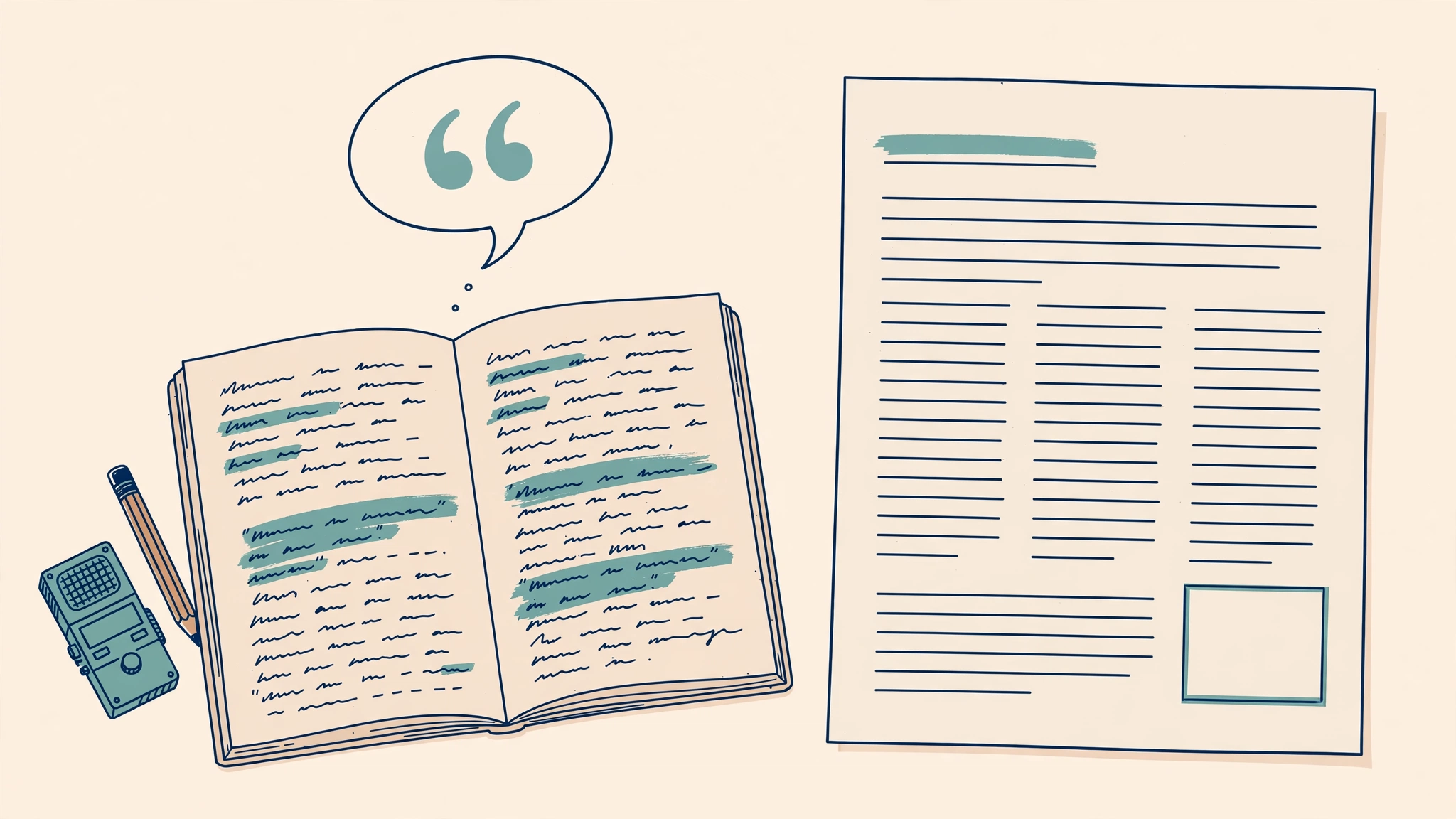
Interview notes are the messiest raw material in writing. Half-finished sentences, a quote you caught word for word next to one you only half heard, a brilliant line buried in the middle of a ramble about someone’s commute. And yet the best articles I’ve ever written started exactly there — not with a blank page, but with a page full of someone else’s words.
The problem isn’t the notes. It’s what happens between the notes and the article. Most writers either copy the notes too faithfully and end up with a transcript nobody wants to read, or they hand the whole mess to AI and get back a smooth, confident article that quietly invents the parts it couldn’t read. I’ve done both. Here’s the workflow I use now — the one that keeps the person’s voice in the piece and still gets it done in an afternoon.
1. Clean the notes before AI ever sees them
This is the step everyone skips, and it’s the one that decides whether the final article is accurate. AI can’t tell the difference between a direct quote and something you paraphrased in a hurry. If you feed it messy notes, it will treat your guesses as facts.
Spend fifteen minutes on the notes first. Mark every direct quote clearly — I put them in quotation marks and add the speaker’s initials. Flag anything you’re unsure about with a question mark in brackets, like [did she say 2019 or 2021?]. Cross out anything you know is wrong rather than leaving it in to confuse the model later.
You’re not editing for style here. You’re building a fence around the facts. Everything inside the fence is safe for AI to use. Everything outside it isn’t.
2. Brief the AI like a junior writer, not a search engine
Don’t paste your notes and type “turn this into an article.” That prompt gets you a generic summary with your interviewee’s name pasted on top.
Instead, give it the same brief you’d give a junior writer: who the article is for, what the reader should take away, the tone you want, and the structure you have in mind. Mine usually looks like this: “Write a 900-word article for freelance writers based on these interview notes. The reader should finish knowing how a working journalist actually prepares for an interview. Keep the interviewee’s own words in quotes — don’t paraphrase quotes. Use subheadings. Don’t add facts that aren’t in the notes.”
The last line matters most. AI fills gaps by default; it’s helpful by design. Telling it explicitly not to invent anything is the single most important sentence in the brief. I also ask it to mark anything it had to guess, so I can check those spots myself.
3. Let AI build the structure, not the sentences
The first draft AI produces is scaffolding, not the article. I read it for one thing only: does the structure work? Does the opening earn the reader’s attention, do the sections flow in a sensible order, does the ending land?
Usually the answer is mostly yes, and that’s the point. Structuring is the part of this job AI is genuinely good at. It sees the shape of the material faster than I do, because it isn’t attached to any particular line.
But I almost never keep AI’s sentences. They’re too smooth, too balanced, too much like every other article on the internet. Once the structure is right, I rewrite the piece in my own voice, keeping the structure and the quotes and replacing nearly everything else. The AI draft becomes an outline with training wheels.
4. Protect the quotes — they’re the whole point
Here’s the rule I never break: a direct quote from the interview can only be shortened, never rewritten. I can cut words out of a quote with an ellipsis. I can choose a better starting point. But I cannot change the words, smooth the grammar, or “improve” the phrasing. The moment I do, it stops being a quote and becomes something I made up and put in someone’s mouth.
AI doesn’t understand this distinction, and it will happily polish a quote until it sounds like the model wrote it. So I check every quote in the final draft against my cleaned notes, word for word. It takes five minutes and it’s the most important five minutes of the whole process. If a quote reads awkwardly in the article, that’s the interviewee’s voice — and it’s usually the most interesting sentence on the page.
One practical trick: when I ask AI to draft around the quotes, I tell it to leave the quotes exactly as written and build the transitions between them. That division of labour works well — AI writes the connective tissue, the human being supplies the substance.
5. Add the one thing AI can’t: the room
An interview isn’t just words. It’s the pause before an answer, the laugh at a question, the thing someone said after you switched the recorder off. AI has none of that, and if you leave it out, your article reads like a press release.
For every interview article, I add at least one detail AI couldn’t know: how the person reacted to a question, what their workspace looked like, the story they told that didn’t fit the official narrative. It doesn’t have to be dramatic. “She laughed and said she’d tried that once and it went badly” does more for an article than three polished paragraphs.
This is also what makes the article unmistakably yours. Ten writers could interview the same person with the same notes. Only you were in the room.
6. Fact-check against the notes, not the draft
When the article is finished, I do one final pass with the notes open beside it. Not against the AI draft — against the original notes. I’m looking for three things: anything attributed to the interviewee that they didn’t actually say, any number or date that drifted, and any claim the article makes that the notes don’t support.
AI is remarkably good at inventing plausible specifics. A “five-person team” becomes “a team of six.” A project from “last spring” becomes “in March 2024.” These errors are small, plausible, and exactly the kind of thing that makes an interviewee email you the next day. The notes are the only source of truth, so check against them directly.
The honest truth
Interview notes are awkward raw material, and that’s precisely why they produce good articles. A blank page invites generic writing. A page full of someone’s real words, half-finished sentences and all, forces you to write about something that actually happened to someone who actually said it.
AI makes the middle of that job faster — the structuring, the first pass, the connective tissue. It doesn’t make the job easier in the ways that matter. You still have to protect the quotes, check the facts, and put yourself in the room. Skip those steps and you don’t have an interview article. You have a well-written guess.
Do it properly, though, and the result is something neither you nor the AI could have produced alone: a polished article that still sounds like the person you sat down with.
Frequently Asked Questions
Can AI transcribe my interview notes accurately?
Transcription tools are good at clean audio and bad at everything else — names, numbers, accents, crosstalk. Treat any transcript as a rough draft of the conversation, and check every quote you plan to publish against the recording or your handwritten notes. A transcript you haven’t verified is a rumour with timestamps.
Should I let AI write the whole article from my notes?
You can, but you shouldn’t publish what it gives you. Let AI build the structure and the first pass, then rewrite the sentences yourself, check every quote against the notes, and add the details only you know — the room, the reactions, the aside after the recorder stopped. That’s the part that makes it an interview article instead of a summary.
What do I do with a quote AI paraphrased?
Don’t publish it as a quote. Either restore the exact wording from your notes or the recording, or turn it into indirect attribution — “she said the launch had taken twice as long as planned” instead of invented quotation marks. A paraphrase in quotes is a fabrication, even when the meaning is roughly right.
My notes are a mess. Can I still use them?
Yes — messy notes are normal. Spend fifteen minutes cleaning them before AI sees them: mark the direct quotes, flag anything you’re unsure about, cross out what’s wrong. If a fact can’t be verified from the notes or the recording, leave it out or ask the interviewee. An article with one fewer fact beats an article with one wrong one.
Continue your workflow
Was this guide helpful?
Tell us what needs improving →
Your selection stays on this page. To send feedback to the publication, use our contact form.
Published 8 November 2026 · Text Craft Pro · AI-assisted educational writing. Editorial policy · Suggest a correction