Planning
How to Build an Article Outline Around the Reader’s Questions
Turn a topic into a useful sequence of questions, examples, and next steps before writing the full draft.
An outline is a sequence of decisions about what the reader needs and when they need it. It is more useful than a list of headings copied from other articles. A strong outline lets you test the explanation before investing in polished paragraphs. It also helps an editor spot repeated sections, unsupported conclusions, and missing practical details.
Write the central question
Reduce the assignment to a question that one article can answer. “How do I prepare a writing brief?” creates a clearer boundary than “content strategy.” Put the proposed answer beside the question in a few sentences. If you cannot state an answer yet, you may need research rather than a longer outline. Keep the question visible while drafting so each section can earn its place.
Collect the necessary supporting questions
List what a reader must understand to use that answer. For a brief, those questions might cover audience, scope, evidence, and review. Separate essential questions from interesting tangents. You can preserve useful tangents as future article ideas instead of forcing them into this piece. The aim is to make a complete answer to a defined problem, not to include everything you know about the topic.
Choose an order that reduces confusion
A tutorial often needs preparation before action and checks after action. A decision guide may need criteria before examples. A troubleshooting article should distinguish the symptom from possible causes before suggesting changes. Read the headings as a conversation: does each answer create a reasonable reason to read the next? If the reader must jump ahead to understand an earlier section, move the prerequisite explanation forward.
Assign a job to each section
Add a short note under every heading describing the point, evidence, and example it will contain. Two sections with the same note probably overlap. A section with no evidence may need qualification or removal. This small exercise stops attractive headings from hiding an empty explanation. It also makes handoffs easier because another writer can see why the section exists rather than treating its wording as sacred.
Test the outline with an example
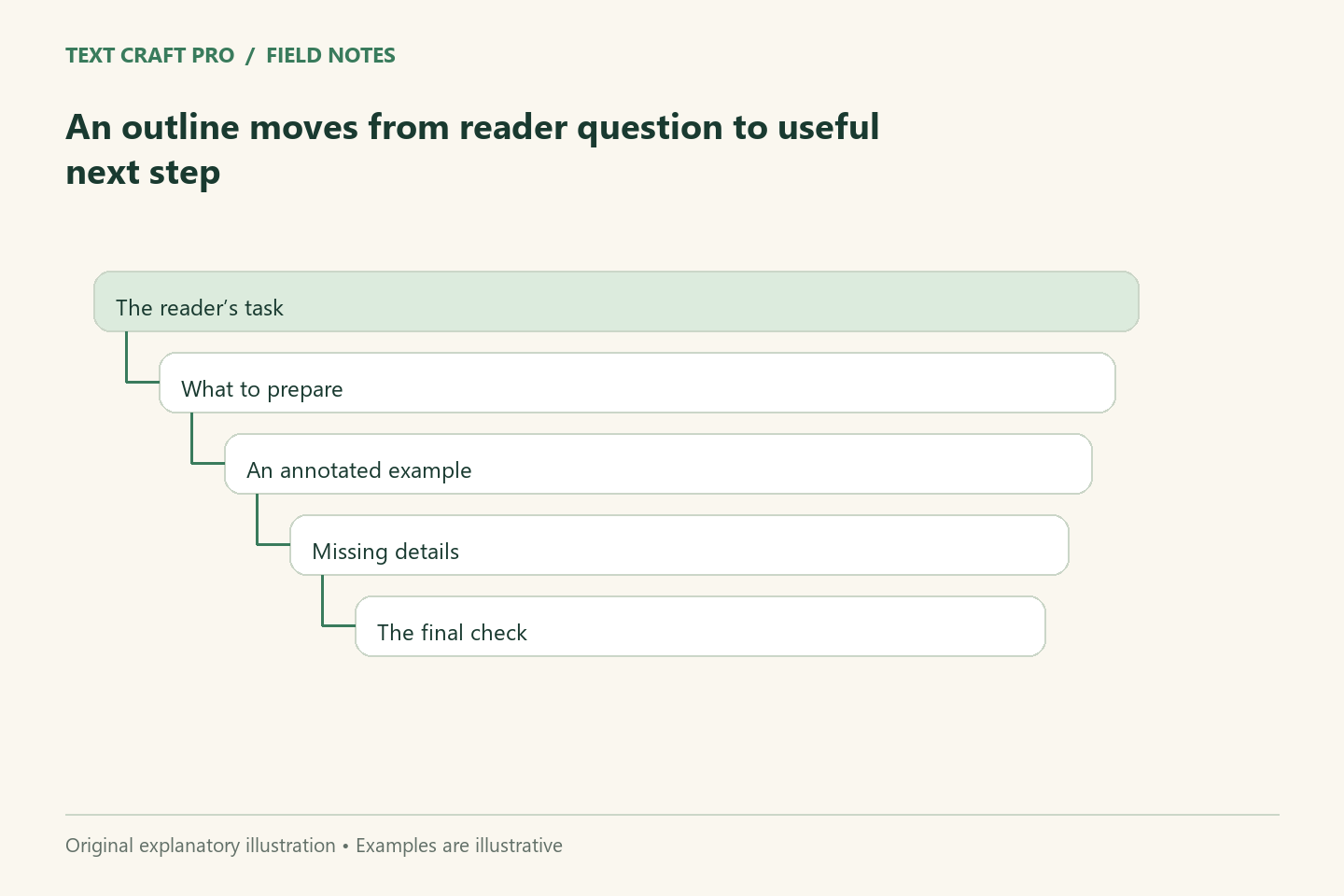
For a fictional guide to customer enquiries, use this order: what the enquiry should achieve; the minimum details to collect; a short annotated example; how to handle missing information; what to check before sending. The example belongs after the criteria because the reader can then understand the choices. A separate section about every possible communication channel would distract from the guide’s immediate task.
Revise after the first draft
An outline is a working structure. Drafting can reveal that two ideas belong together or that an example explains a rule more quickly. Update the outline to reflect the better argument. Before publication, compare the final contents list with the promised outcome. Remove sections that add length without answering a new question, and add a clear next step rather than a conclusion that merely repeats the introduction.
Frequently asked questions
Can I use the same outline for every article?
A reusable checklist helps, but the actual order should follow the article’s task. Tutorials, comparisons, and troubleshooting guides need different structures.
How many headings are enough?
Use the number needed to organize the answer. There is no heading count that guarantees reader satisfaction or search rankings.
Continue your workflow
- How to Write a Content Brief That Gives a Writer a Clear Starting Point
- How to Give Every Paragraph a Clear Job
Was this guide helpful?
Tell us what needs improving →
Your selection stays on this page. To send feedback to the publication, use our contact form.
Published 15 August 2026 · Text Craft Pro · AI-assisted educational writing. Editorial policy · Suggest a correction