Editing
How to Give Every Paragraph a Clear Job
Use a point, supporting detail, and a meaningful connection to build paragraphs that move the explanation forward.
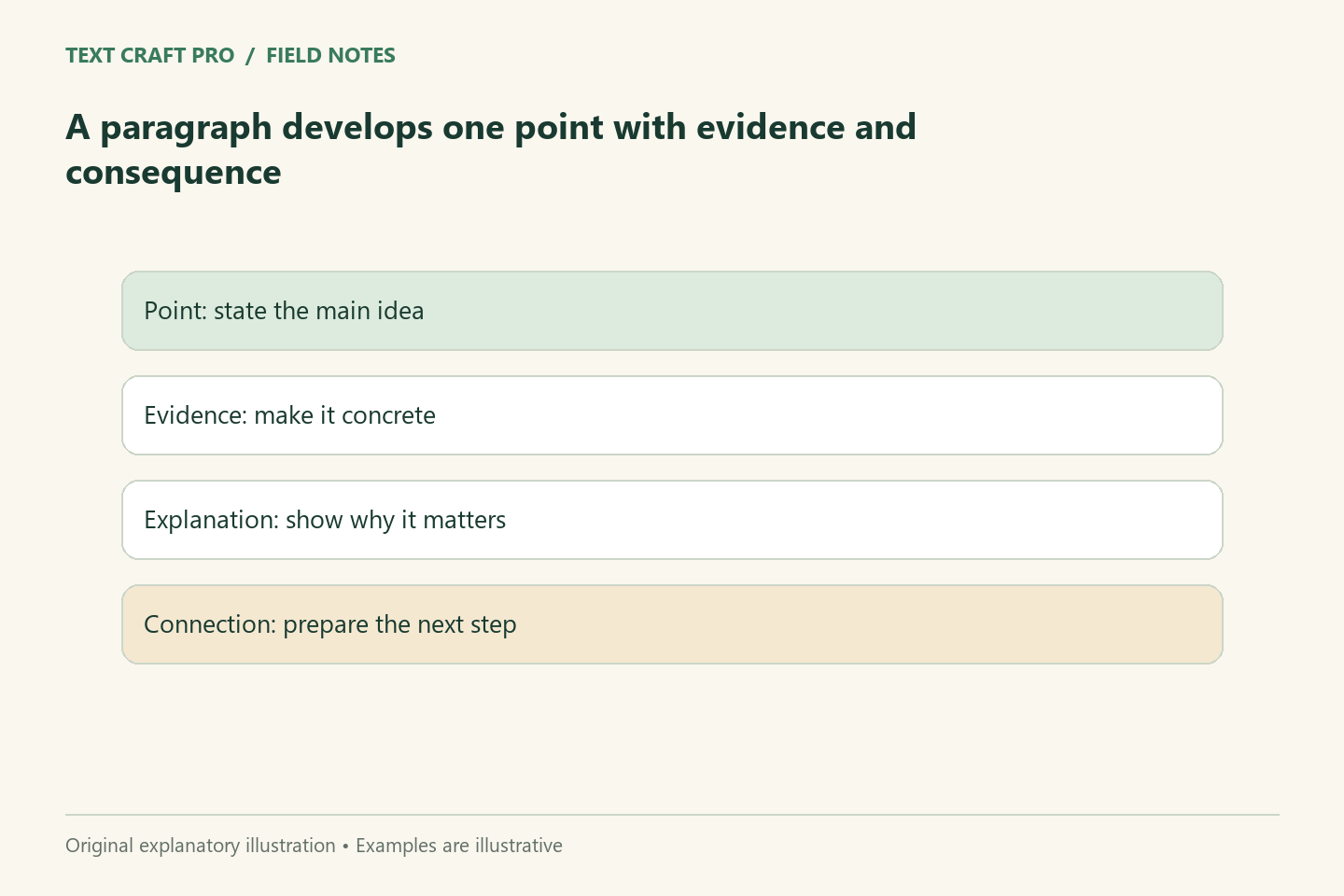
A paragraph is a unit of explanation, not simply a block of a certain length. It should develop a point the reader can identify and connect that point to the article’s larger task. When paragraphs feel heavy or repetitive, the problem is often unclear purpose rather than the number of sentences. Editing their jobs first can improve the whole draft.
Summarize the paragraph’s purpose
Write a few words beside the paragraph describing what it contributes: define a term, explain a risk, demonstrate a step, or qualify a claim. If you need two unrelated descriptions, consider splitting it. If the description repeats the previous paragraph’s job, combine the useful details and remove the repetition. This produces a more meaningful edit than cutting sentences at random until the page looks less dense.
Make the point discoverable
Readers should not have to infer the paragraph’s central idea from several vague opening sentences. Put the point early when that helps the explanation. An example can sometimes lead, especially when it makes an abstract issue concrete, but connect it promptly to the claim it demonstrates. Avoid opening with a broad statement that could appear in almost any article. A specific point gives the next sentences something to develop.
Choose supporting details that do real work
Evidence, an example, a reason, or a qualification should make the point easier to understand or assess. A second sentence that only restates the first in different words may not help. Ask what the reader now knows that they did not know one sentence earlier. If a detail is interesting but not relevant to the point, move it to a better section or save it for another piece.
Connect the point to its implication
After explaining a detail, show why it matters for the reader’s task. A paragraph about unclear ownership might end by explaining who must resolve the missing decision before drafting. Avoid adding a miniature summary to every paragraph; the connection can be built into the final example or instruction. What matters is that the reader can see how the point changes their understanding or next action.
Use a worked revision
Fictional draft: “Briefs are important. They help writers. A writer needs information. The information should be clear.” Revision: “A brief should name the reader’s next decision. If a guide is meant to help a customer prepare an enquiry, required details belong ahead of general benefits. That choice gives the writer a practical test for deciding what to include.” The revision develops one point through a relevant example and an editing consequence.
Review the sequence between paragraphs
Read only the first sentence of each paragraph. This is not a universal test, but it can expose a stalled explanation or an abrupt topic change. Then read the full text to make sure transitions describe a real relationship: cause, contrast, sequence, or consequence. Adding connecting words will not repair unrelated ideas. Move the paragraphs until the explanation makes sense, then refine the wording.
Frequently asked questions
How many sentences should a paragraph contain?
There is no fixed requirement. Use enough to develop its point, considering screen size, reading context, and the complexity of the idea.
Can a paragraph contain more than one idea?
It can contain several related details that develop a central point. Unrelated points usually need separate paragraphs.
Continue your workflow
- How to Build an Article Outline Around the Reader’s Questions
- A Three-Pass Editing Workflow: Structure, Sentences, and Final Checks
Was this guide helpful?
Tell us what needs improving →
Your selection stays on this page. To send feedback to the publication, use our contact form.
Published 21 August 2026 · Text Craft Pro · AI-assisted educational writing. Editorial policy · Suggest a correction