Editing
A Plain-Language Editing Pass That Preserves the Meaning
Replace vague phrases, reveal the action, and explain necessary terms without oversimplifying the message.
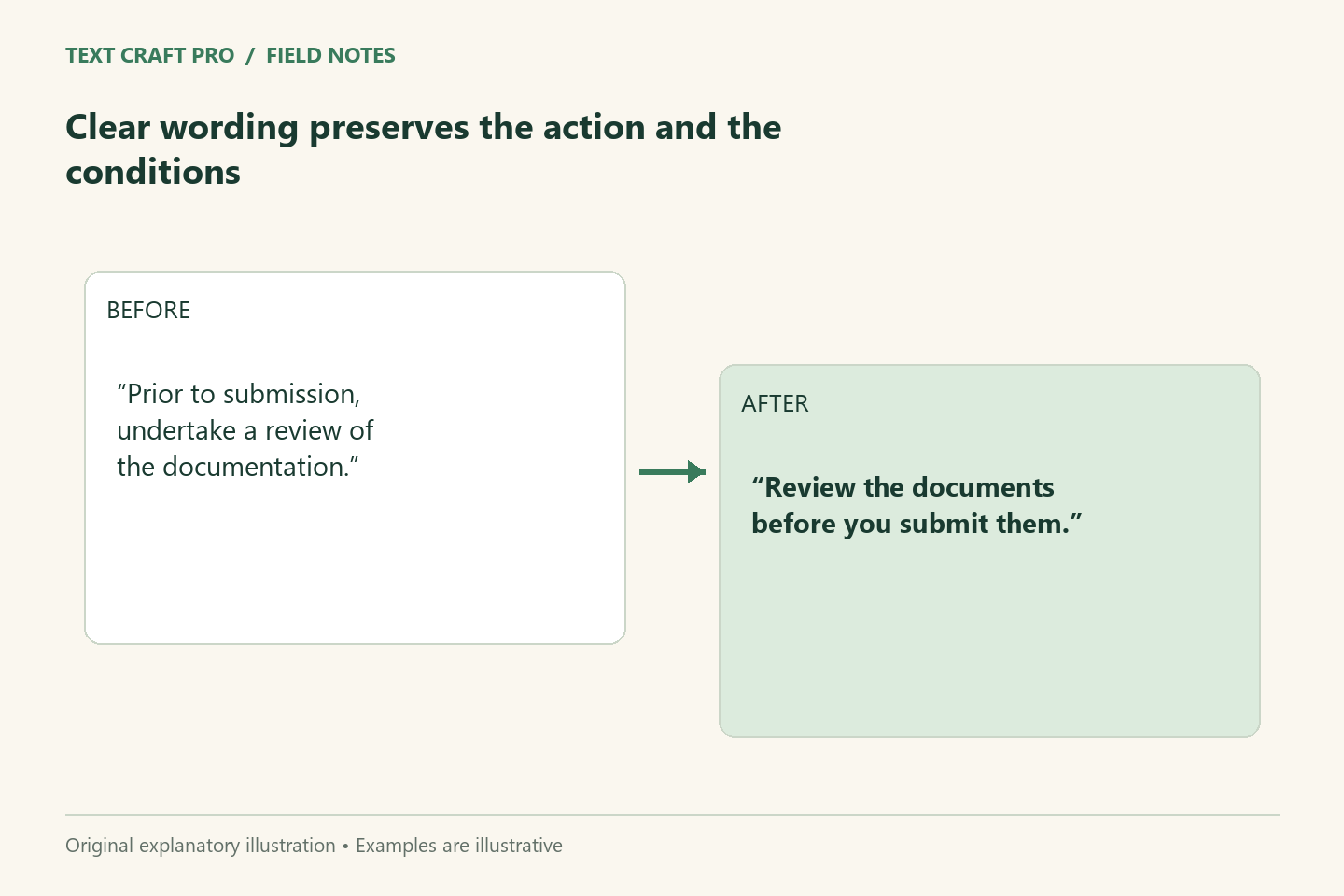
Plain-language editing makes a message easier to use while preserving what it needs to say. The goal is not to make every sentence short or remove every technical term. It is to help the intended reader identify the action, understand the conditions, and avoid a preventable misunderstanding. Start with meaning before looking for smaller words.
Identify who does what
Underline the action in a sentence and name the person responsible for it. “The completion of the form is required” leaves the action less direct than “Complete the form before your appointment.” Sometimes the actor is unknown or unimportant, so passive wording can be appropriate. Use the form that makes responsibility clear for this reader rather than treating a grammatical preference as an absolute rule.
Replace vague instructions with usable details
Words such as soon, appropriate, and necessary can hide a missing decision. If a deadline is known, state it. If several documents are acceptable, name them or link the approved list. Do not invent a deadline simply to make the writing more specific. Mark the missing information for the process owner. Editing can expose gaps in a procedure, but it cannot authorize new business commitments.
Explain terms the reader needs
A technical term may be the correct word. Define it when the reader needs the meaning, then use it consistently. Avoid replacing one precise term with several loose synonyms merely for variety. If the reader already knows the term, repeated explanations can slow them down. The brief should identify that knowledge level, and the draft should offer enough context for people who arrive at an individual section through a link.
Keep conditions beside the instruction
Separate sentences can accidentally separate an action from its exception. “Submit a signed copy” may be incomplete if digital signatures are accepted only for certain documents. Keep that condition nearby and explain what to do when it is not met. Use a short list for several independent requirements, but preserve the relationship between them. Formatting should make the logic easier to see rather than flattening it.
Compare an original and revision
Fictional original: “In the event that clarification is deemed necessary, a communication should be initiated.” Revision: “If a required detail is unclear, ask the project owner before drafting.” The revision names the condition, actor, and action. It still needs the brief to identify the project owner. A second revision might link the owner’s role rather than adding a private contact address to a public example.
Test clarity without assuming a score proves it
Ask someone from the intended audience to explain the instruction in their own words. Their misunderstanding is useful evidence for another pass. Our text analyzer can count words and estimate reading time, but it cannot verify meaning or accessibility compliance. Readability formulas and sentence length can flag patterns; a reader’s ability to complete the task remains a stronger practical check.
Frequently asked questions
Should all sentences be short?
No. Vary length where it helps the explanation. Split a sentence when its relationships or conditions become hard to follow.
Does plain language mean casual language?
No. A clear message can remain formal, technical, or sensitive to the situation. Match the tone to the reader and task.
Continue your workflow
Was this guide helpful?
Tell us what needs improving →
Your selection stays on this page. To send feedback to the publication, use our contact form.
Published 19 August 2026 · Text Craft Pro · AI-assisted educational writing. Editorial policy · Suggest a correction