Editing
How to Edit a Sentence Without Changing What It Means
Check actors, actions, conditions, and emphasis before shortening a sentence. Includes an annotated before-and-after example.
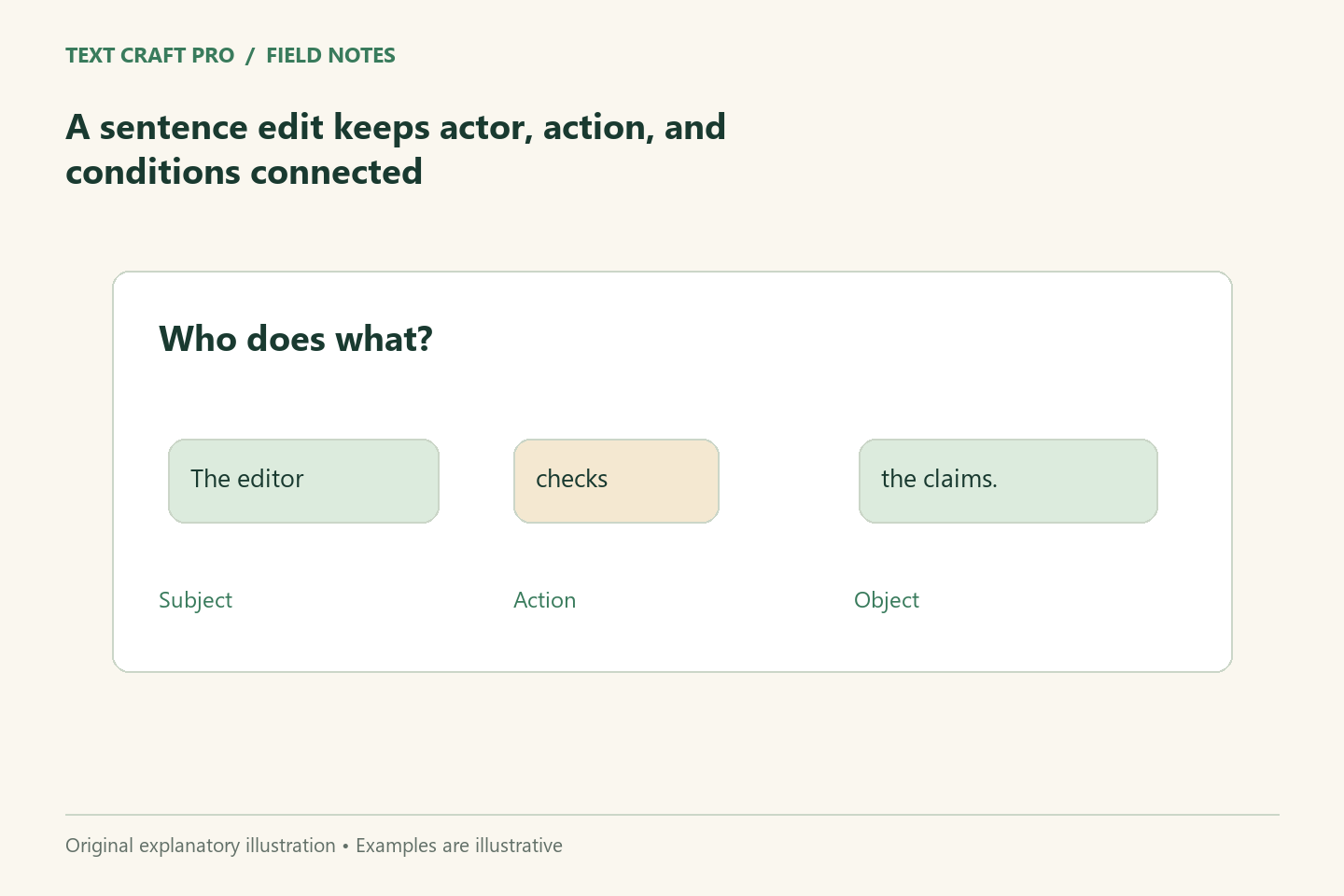
A sentence can sound smoother after an edit and still become less accurate. Shortening may remove a condition, change who is responsible, or make an uncertain result sound guaranteed. A reliable sentence edit starts by identifying the meaning that must survive. Then you can improve the wording without turning a style preference into a different instruction.
Write down the meaning before rewriting
Identify the actor, action, object, and relevant condition. In “After approval, the editor may publish the draft,” approval is required and publishing is permitted, not automatic. Removing “may” changes that distinction. If the original is ambiguous, ask the owner which meaning is intended. Do not use fluent wording to conceal a decision the draft has not yet made.
Find the real action
Some sentences hide their action inside a noun phrase: “make a determination,” “conduct a review,” or “provide an explanation.” A verb can often express the action more directly. Compare “The reviewer will make a determination about accuracy” with “The reviewer will check accuracy.” The second version is clearer if checking is the intended action, but it might be incomplete if the reviewer also decides whether publication can proceed.
Move important relationships close together
Long interruptions between subject and verb can make a reader lose the main action. Place qualifications where their scope is clear. If an exception applies to one step, keep it beside that step rather than at the end of a paragraph about several steps. You can split the sentence, but preserve the relationship explicitly. Two short sentences can be more misleading than one longer sentence if the exception appears disconnected.
Choose emphasis deliberately
The beginning and ending of a sentence can affect what the reader notices. Put the instruction before background when the immediate task matters most. Put necessary context first when the instruction would otherwise be confusing. Consider the surrounding paragraph rather than judging the sentence alone. Repeating a key term can be useful when replacing it with a pronoun would make the reference unclear.
Compare a worked revision
Fictional original: “The draft, following the completion of a review by the project owner and provided that no required facts remain unresolved, can be scheduled.” Revision: “Schedule the draft after the project owner approves it and all required facts are resolved.” The revision is shorter but stronger: it changes permission into an instruction. If that is not intended, use “You can schedule the draft…” instead. The better version depends on the process, not just elegance.
Check what the edit removed
Compare the original and revision side by side. Look specifically for conditions, uncertainty, responsibility, dates, and exceptions. Read the revised sentence within its paragraph to test references and emphasis. Our text analyzer can show a changed word count, but it cannot decide whether the meaning is preserved. That judgment belongs to the writer and the person responsible for the facts.
Frequently asked questions
Should I always use active voice?
Use the form that makes the intended meaning clear. Passive wording can be useful when the actor is unknown or the result matters more.
Is the shortest revision the best?
No. Keep the information necessary for an accurate and usable message. Brevity is useful only when it preserves the task.
Continue your workflow
- A Plain-Language Editing Pass That Preserves the Meaning
- How to Cut Wordiness While Keeping Useful Detail
Was this guide helpful?
Tell us what needs improving →
Your selection stays on this page. To send feedback to the publication, use our contact form.
Published 25 August 2026 · Text Craft Pro · AI-assisted educational writing. Editorial policy · Suggest a correction