Editing
How to Cut Wordiness While Keeping Useful Detail
Find repeated explanations, empty framing, and unnecessary noun phrases without stripping the draft of evidence and context.
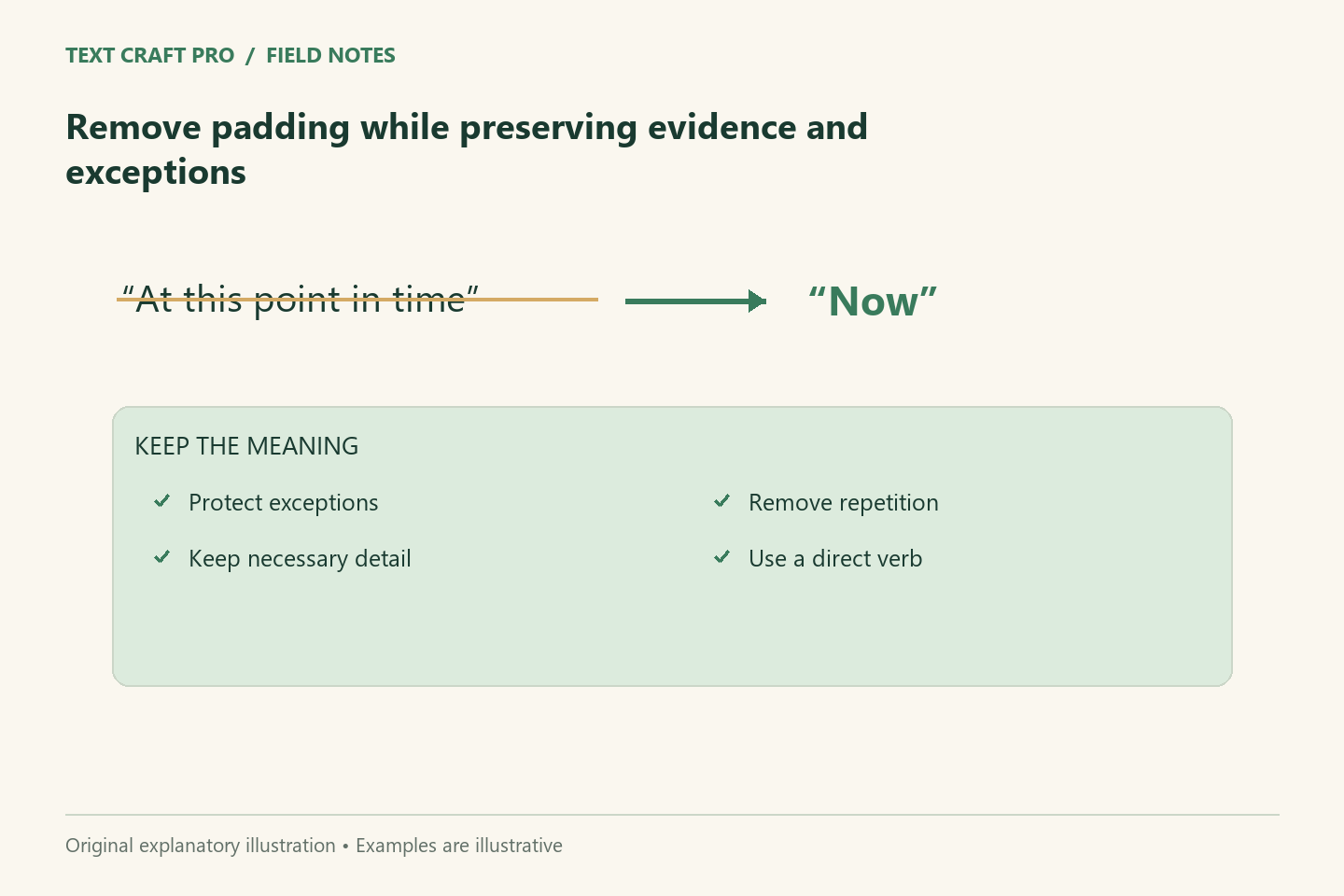
Wordiness is not the same as length. A long tutorial can earn its space by explaining prerequisites, examples, and exceptions. A short paragraph can still repeat the same point three times. The useful editing question is what each phrase contributes. Cut language that adds no meaning, while keeping details that let the reader understand, assess, or use the answer.
Cut repeated meaning before individual words
Look for nearby sentences that make the same claim. “A brief helps the writer understand the assignment” and “It gives clarity about what the writer should produce” may overlap. Keep the stronger sentence and use the space for a concrete example. Repetition can be useful for instructions that readers encounter separately, but within a short passage it should have a clear reason.
Remove empty opening frames
Phrases such as “It is important to note that” often delay the point. Try beginning with the information that follows. “It is important to note that the source is outdated” becomes “The source is outdated.” If the frame expresses a real qualification, preserve that qualification. “According to the current manual” identifies evidence and should not disappear merely because the sentence would be shorter without it.
Replace inflated phrases carefully
Try simple verbs for phrases such as “carry out an evaluation” or “undertake an examination.” Check whether the replacement preserves the original scope. “Evaluate” may work where “check” would be too narrow. Avoid replacing precise terminology with a loose word for the sake of sounding conversational. The intended audience and subject determine what needs explanation, not a universal list of forbidden words.
Protect evidence and exceptions
Examples, source details, and limitations can make an article longer while making it more useful. Cut the sentence that announces there will be an example before cutting the example itself. Keep the condition that changes whether a reader should follow an instruction. A draft that sounds confident because its uncertainties were deleted is weaker, even if its word count falls dramatically.
Use a fictional example
Original: “For the purpose of ensuring that the content is suitable for the intended audience, it is recommended that a review of the terminology used is conducted.” Revision: “Review the terminology for the intended audience.” If a specific reviewer is required, add that role. If the draft must explain how to review, follow with a method: mark unfamiliar terms, define necessary ones, and remove unexplained abbreviations. The concise instruction is the start of a useful explanation, not a substitute for one.
Review the result at two levels
Use a paragraph-level pass for repeated reasoning and a sentence-level pass for padding. Then compare the revision with the brief. Did you remove something the reader needs to complete the task? Our repetition finder can flag recurring phrases, but a recurring technical term may be appropriate. Treat its results as an inspection list rather than commands to delete every match.
Frequently asked questions
Should I target a percentage reduction?
A target can create pressure to cut useful material. Judge the draft against its purpose, then record the result if a length limit is part of the assignment.
Can repetition ever help?
Yes. It can preserve terminology, reinforce a safety condition, or support readers who enter at different sections. Keep it when its purpose is clear.
Further reading
Continue your workflow
Was this guide helpful?
Tell us what needs improving →
Your selection stays on this page. To send feedback to the publication, use our contact form.
Published 27 August 2026 · Text Craft Pro · AI-assisted educational writing. Editorial policy · Suggest a correction