Business Writing
How to Write a Small Brand Voice Guide That People Can Use
Turn abstract tone labels into practical examples, boundaries, and revision choices for a consistent writing voice.
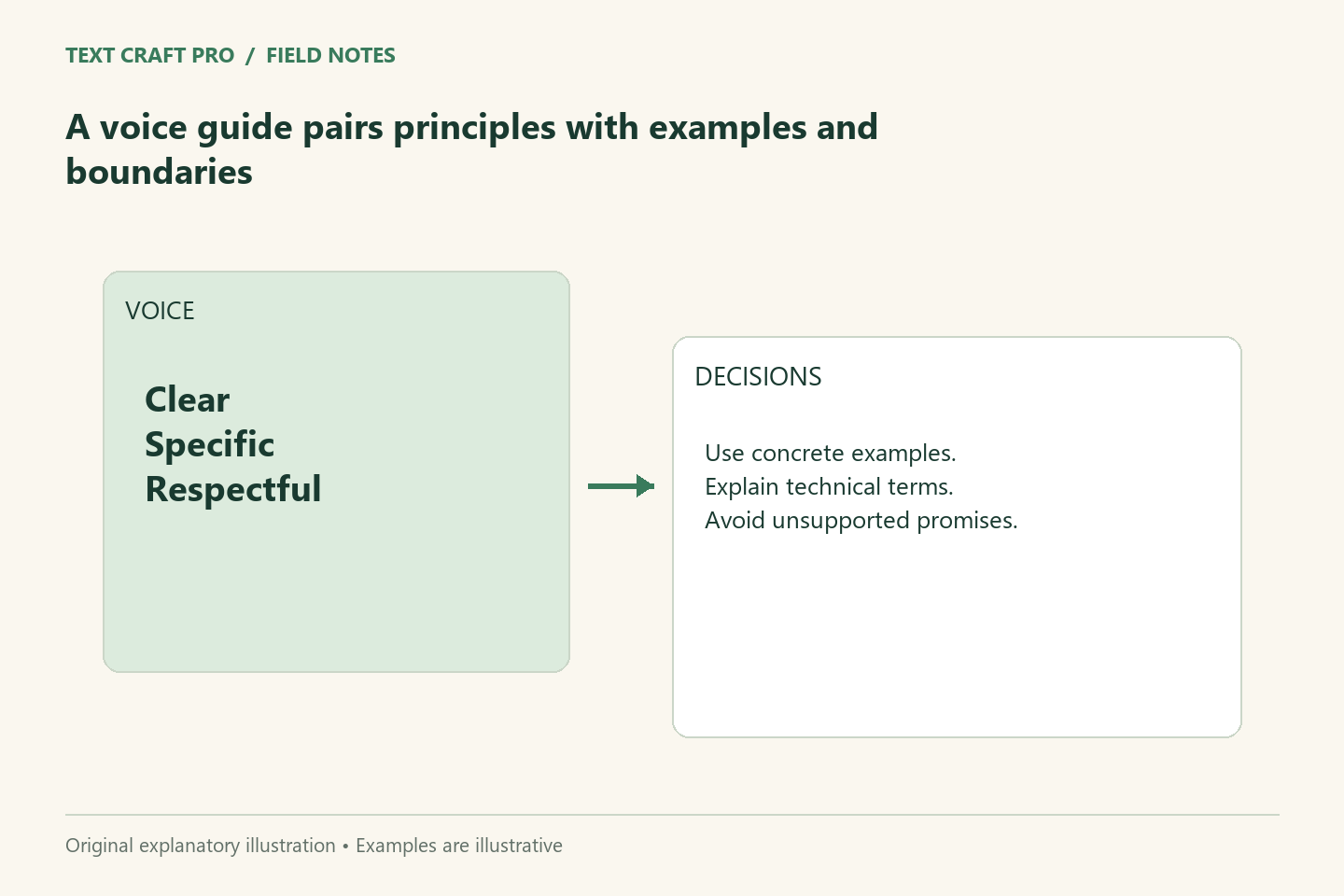
A brand voice guide should help a writer make a choice while drafting. Labels such as friendly, professional, and confident are too broad on their own. Different writers can interpret them in incompatible ways. A compact guide becomes useful when it explains what those labels mean for your audience and shows how they change actual sentences.
Start with the reader relationship
Describe how the business should relate to the reader: a clear instructor, a helpful service team, or a concise technical reference. Explain the reader’s situation and what they need from the message. This is more actionable than choosing adjectives because they sound attractive. A support message and a product announcement can share a voice while responding to different needs and emotions.
Limit the principles
Choose a few principles that guide real decisions. For example: specific rather than sweeping; warm without forced familiarity; direct about limitations. Under each principle, write what the writer should do. “Be specific” might mean naming the action and approved deadline. “Warm” might mean acknowledging the problem before explaining the next step. Avoid a long list that asks for every possible positive quality at once.
Create paired examples
Use fictional examples or authorized material. Show an unsuitable sentence, a preferred revision, and the reason for the change. “We revolutionize all your workflows” could become “Use the checklist to plan one repeatable workflow.” The revision is narrower because the evidence supports a practical tool, not a universal claim. Examples make the guide easier to apply than a list of abstract preferences.
Define boundaries and exceptions
State what the voice should avoid: invented urgency, unsupported superlatives, jokes in a serious complaint, or confusing internal terminology. Explain when tone changes while the core voice stays consistent. A service interruption requires direct facts and a clear update path. The guide should not require cheerful language that minimizes the reader’s problem. Accuracy and empathy matter more than keeping every message upbeat.
Build a one-page working guide
For a fictional writing studio, the guide could contain three principles, one approved introduction, one enquiry response, and one correction notice. Add a short list of terms used consistently. Name the person who resolves disputed wording and the date of the latest review. This makes the guide a maintained working reference rather than a brand document that only exists during an initial project.
Test the guide on different formats
Ask two writers to revise the same short message using the guide. Compare the choices and identify unclear instructions. Then test a headline, a help article, and an email. If the guide only works for promotional copy, add examples for the less comfortable situations. Update examples when the business changes its services, but do not change factual commitments solely to achieve a preferred tone.
Frequently asked questions
Is voice the same as tone?
Voice is the consistent character of the writing. Tone is how that voice responds to a specific context and reader.
Should every sentence sound distinctive?
No. A useful voice can be recognizable through clarity and consistency. Making every instruction clever can make it harder to use.
Continue your workflow
- How to Change the Tone of a Message Without Changing Its Facts
- How to Write a Business Email With a Clear Purpose and Next Step
Was this guide helpful?
Tell us what needs improving →
Your selection stays on this page. To send feedback to the publication, use our contact form.
Published 29 August 2026 · Text Craft Pro · AI-assisted educational writing. Editorial policy · Suggest a correction