Editing
The Editing Checklist I Run on Every AI Draft
I used to edit AI drafts by mood, which meant the first three paragraphs shone and the rest sagged. Now I run the same seven passes in the same order, every time — here is the checklist.
 Written by Daniel Carter
Daniel Carter writes and edits practical guides on writing, editing, and publishing at Text Craft Pro, based on hands-on testing and documented examples.
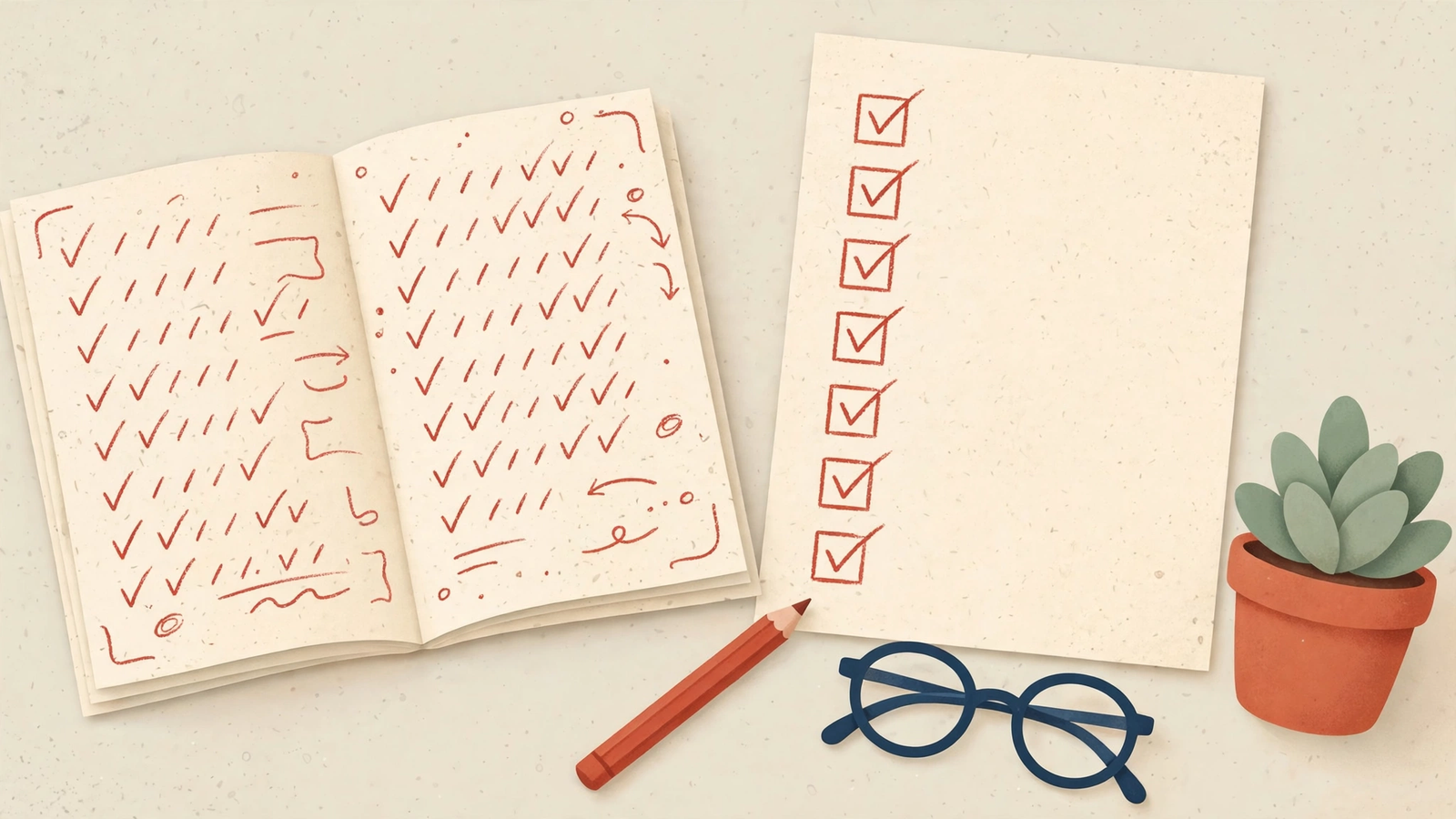
I used to edit AI drafts the way most people do: open the document, start at the top, and fix whatever annoyed me until I got tired. Some days that meant a careful edit. Most days it meant I fixed the first three paragraphs properly, skimmed the rest, and published something half-edited with full confidence.
The problem with editing by mood is that it’s uneven. The beginning shines, the middle sags, and the ending still has the AI’s fingerprints all over it. So I stopped improvising and started running the same checklist on every draft, in the same order, no matter how good the first version looks. It takes about twenty minutes on a typical blog post, and it’s the single biggest reason my edited drafts actually sound like me.
Here’s the checklist, in the order I run it.
1. Read it cold, without touching anything
Before I change a single word, I read the whole draft start to finish — no editing, no highlighting, no fixing typos as I go. I’m reading for one thing only: does the argument hold together? Does each section earn its place, and does the piece end where it promised to begin?
AI drafts almost always have a structural wobble somewhere. A section that repeats the introduction in different words. A conclusion that introduces a brand-new point. A paragraph that belongs two sections earlier. You can’t see those problems while you’re line-editing, because line-editing narrows your vision to one sentence at a time. The cold read is the only pass that sees the whole shape.
If something’s structurally wrong, I fix it here — move the paragraph, cut the redundant section, rewrite the ending — before I spend a minute polishing sentences that might get deleted anyway.
2. Cut the filler, then cut a little more
AI overwrites. It’s not a flaw exactly; the model would rather give you too much than too little. But the surplus shows up as throat-clearing intros, sentences that restate the previous sentence, and summaries of summaries.
On this pass I delete whole sentences, not words. My test is simple: if I remove the sentence and the paragraph still makes its point, the sentence goes. I also hunt the usual filler phrases — “in today’s fast-paced world,” “it’s important to note that,” “delve into,” “a wide range of” — and replace each with something specific or nothing at all.
Most drafts lose 10 to 15 percent here. That’s not damage; that’s the draft getting closer to what a human would actually write. Nobody has ever complained that a blog post was too tight.
3. Check every fact, name, and number
This is the pass people skip, and it’s the one that matters most. AI drafts state things confidently whether they’re true or not. A statistic with no source. A tool described as free when it went paid last year. A quote attributed to the wrong person. A “recent study” that doesn’t exist.
I verify every checkable claim in the draft: numbers, dates, prices, names, tool features, quoted words. If I can’t verify it in a couple of minutes, it comes out or gets softened into something I can stand behind. “Studies show” becomes “in my experience” when there’s no study. A precise-sounding number with no source becomes no number at all.
One unverified fact in an otherwise good article does more damage than ten awkward sentences. Readers forgive clumsy writing. They don’t forgive being misled.
4. Put your voice back in
By now the draft is structurally sound, leaner, and true. It’s also usually a bit flat, because passes one through three are all about removing things. This pass is about adding: the specific details only I could write.
I go section by section and add one concrete thing to each — a number from my own work, a moment from a real project, a blunt opinion I actually hold. “I cut 40% of the draft” beats “I significantly reduced the draft.” A sentence about the Tuesday call where a client asked me why their post sounded like everyone else’s beats a generic paragraph about authenticity.
This is also where I rescue the sentences only I would write. Every draft has a few lines with a pulse — an odd comparison, a sharp opinion, a detail the model would never invent. I circle those and build around them. Your voice lives in the lines the model would never generate.
5. Read it aloud
Your ears catch what your eyes forgive. AI writing has a rhythm: smooth, even, slightly sleepy. When you read it out loud, the flat spots announce themselves — you’ll hear yourself going on autopilot, and that’s exactly where your reader would too.
I mark every place where I stumble, rush, or get bored, then rewrite those spots. Usually the fix is simple: a shorter sentence, a more concrete verb, a cut. If a sentence is hard to say, it’s hard to read, and no amount of silent editing will reveal that as reliably as your own voice will.
6. Do the SEO pass last, not first
Keywords, headings, internal links, meta description — all of it comes last, deliberately. If you optimize first, you end up shaping sentences around keywords instead of meaning, and the draft starts sounding like it was written for a search engine.
On this pass I check that the main keyword appears naturally in the title, the first paragraph, and one or two headings — never forced. I add internal links where they’d genuinely help the reader, not where they’d pad a quota. I write the meta description as a one-sentence promise of what the article delivers. If a keyword doesn’t fit naturally anywhere, it doesn’t belong in the article.
7. The final once-over
Last pass, fastest pass. I check the boring stuff that still trips readers up: headings in logical order, no placeholder text left behind, links that actually work, the call to action pointing at the right tool, and the opening line still matching what the article actually delivers. Then I publish.
The whole checklist fits on an index card, and that’s the point. Editing shouldn’t depend on how inspired you feel today. It should be a routine you can run on a tired Tuesday and still trust.
The honest truth
No checklist will save a draft you don’t actually read. The checklist works because it forces you to slow down and look at the draft seven different ways instead of once, and each way catches something the others miss. Skip a pass and whatever that pass catches stays in the article — usually the factual error, usually in the paragraph you were sure was fine.
Run it in order, every time. The first few drafts will feel slow. By the tenth, you’ll wonder how you ever edited without it.
Frequently Asked Questions
How long should the checklist take on a typical blog post?
About twenty minutes on a 1,000-word draft once the routine is familiar. The cold read takes five, the filler cut takes five, and the rest split the remaining ten. Longer or more technical drafts take longer, mostly on the fact-check pass — that’s the one pass you should never rush to save time.
Do I need to run all seven passes on a short post?
Yes, but they shrink. On a 400-word post, the cold read is two minutes and the aloud read is one. The passes that matter most on short pieces are the fact check and the voice pass, because short drafts leave nowhere for errors or flatness to hide.
What if the AI draft is already good — do I still run the checklist?
Especially then. Good-looking drafts are where the sneakiest problems live: a confident statistic with no source, a smooth paragraph that says nothing, a conclusion that quietly contradicts the introduction. The better the draft looks, the more the checklist earns its keep.
Can I change the order of the passes?
The order matters for two pairs: structure before line edits (so you don’t polish sentences you’ll delete), and SEO last (so keywords never shape the writing). Within those constraints, swap the middle passes to suit yourself — but keep fact-checking before the aloud read, so you’re reading a draft you can trust.
Continue your workflow
Was this guide helpful?
Tell us what needs improving →
Your selection stays on this page. To send feedback to the publication, use our contact form.
Published 31 October 2026 · Text Craft Pro · AI-assisted educational writing. Editorial policy · Suggest a correction