Writing
AI vs. Human: Who Should Write Your First Draft?
I used to hand every first draft to AI and fix it after. Some of my best pieces came from the opposite order. Here is the decision I make now, piece by piece, before I open a blank page or a prompt box.
 Written by Daniel Carter
Daniel Carter writes and edits practical guides on writing, editing, and publishing at Text Craft Pro, based on hands-on testing and documented examples.
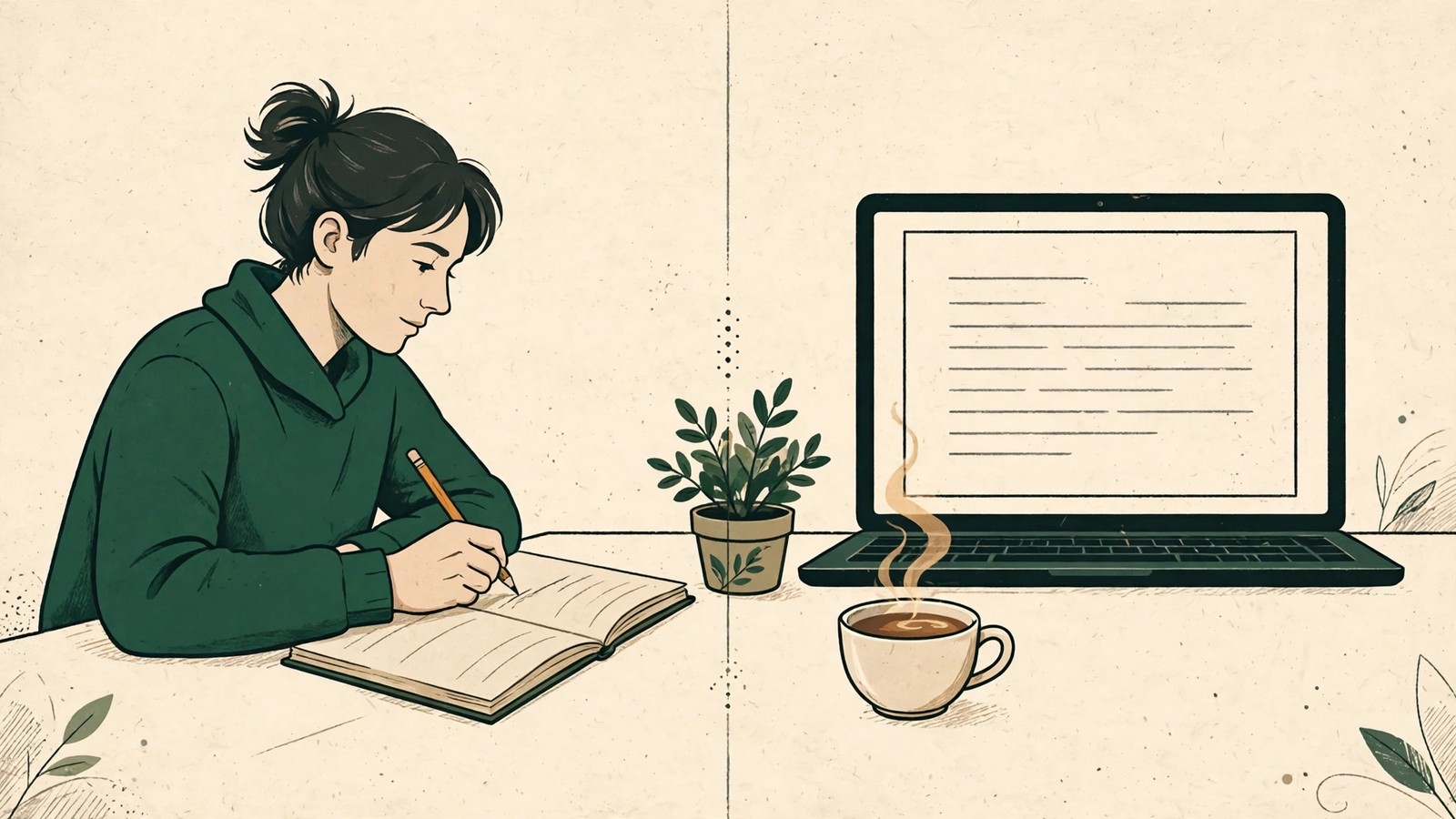
Every piece of writing I publish starts with the same question, and it’s not “what should I write about?” It’s “who writes the first draft — me or the machine?” I used to answer it the same way every time: let the AI draft, then I’ll fix it. Faster, right? Except some of my best pieces came from the opposite order, and some of my worst editing sessions came from a first draft I never should have outsourced. The honest answer is that it depends — on the piece, on what you already know, and on what the draft actually needs to do.
Here’s the decision I make now, before I open a blank page or a prompt box.
Start with what you already know
The single biggest factor is how much you already know about the topic. If I know a subject cold — I’ve done the work, I have the examples, I have an opinion — writing the first draft myself is almost always faster. I can get 500 rough words down in twenty minutes, and those words already sound like me. Handing that job to AI would mean spending an hour sanding someone else’s generic version back toward what I already had in my head.
Flip it around: if I’m writing about something I understand but haven’t thought through yet — a topic I’ve read about but never explained out loud — an AI first draft is genuinely useful. It gives me structure to react to. I read its version, disagree with half of it, and that disagreement is what produces my real argument. The draft wasn’t the writing; it was the sparring partner.
So the first test is simple: could you explain this topic to a friend right now, without notes, for two minutes? If yes, you write first. If you’d stall after thirty seconds, let the machine sketch the shape, then take over.
When an AI first draft wins
There are four situations where I hand the first draft to AI without guilt.
First, the boilerplate piece. Product descriptions, standard how-to steps, meeting summaries, routine emails — writing where the goal is clarity and completeness, not a distinctive point of view. AI is fast, consistent, and doesn’t get bored on step seven. My job becomes checking facts and trimming, not inventing.
Second, the topic where I’m starting from near zero. A research-heavy explainer on something new to me: the AI draft maps the territory — the key terms, the usual structure, the questions readers typically ask. I then verify every claim, because an AI draft on unfamiliar ground is exactly where errors hide. But as a map, it’s worth more than a blank page.
Third, the piece I keep avoiding. We all have one: the post that’s been on the list for three weeks because starting feels heavy. An AI draft breaks the seal. It’s rarely good, but “bad draft exists” beats “perfect draft imagined” every time, and editing a bad draft is psychologically easier than starting from nothing.
Fourth, the format I’ve never written before. My first case study, my first press-style announcement — I didn’t know the conventions, and an AI draft showed me the shape: what goes first, what readers expect, where the quotes land. I rewrote nearly every sentence, but I kept the skeleton.
When you should write first, no matter what
There are also pieces where an AI first draft costs more than it saves.
Opinion pieces, for a start. If the whole point is your judgment — this tool is overrated, that advice is wrong, here’s what I’d actually do — then the first draft IS the thinking. Outsourcing it means outsourcing the opinion, and then you’re just editing someone else’s lukewarm take into something that sounds like you believe it. You don’t. Readers can tell.
Personal stories work the same way. I once let an AI draft the opening of a piece about a failed launch I’d actually lived through. It produced a smooth, plausible, completely hollow paragraph — the kind of “lesson learned” that could belong to anyone. I deleted it and wrote the real version in ten minutes: the awkward client call, the number I got wrong, the fix I stumbled into. The real version was messier and ten times better. No model has your memories. Don’t ask it to fake them.
The third case is the piece where the argument is the hard part. If you don’t yet know what you think — if the thinking itself is the work — writing the first draft yourself is how you find out. I draft longhand-ish for these: messy, half-formed, full of sentences I later cut. The mess is the method. An AI draft would hand me a tidy argument I hadn’t earned, and tidy arguments you haven’t earned fall apart the moment a reader pushes on them.
The hybrid that actually works
Most of my pieces now are neither pure-AI nor pure-human first drafts. They’re a split: I write the hard parts myself, and I let AI draft the easy parts around them.
In practice, that looks like this. I write the opening and the core argument — the two places where voice and judgment matter most — in my own rough words. Then I ask AI to draft the supporting sections: the background, the definitions, the step-by-step walkthrough, the “here’s how it works in practice” middle. Then I edit the whole thing into one voice, which usually means rewriting the AI sections harder than I expected and keeping my own sections nearly as-is.
It works because it respects what each side is good at. I’m good at knowing what matters and why. The machine is good at producing competent filler quickly. The trick is never letting the filler set the direction — the human-written spine decides what the piece says, and the machine-written sections serve it.
A quick decision test
Before your next piece, run through these five questions:
- Could I explain this to a friend for two minutes without notes? If yes, write first.
- Is the point of this piece my opinion or my experience? If yes, write first.
- Is this mostly standard information in a standard format? If yes, let AI draft it.
- Am I stuck starting, or writing in a format I’ve never tried? If yes, let AI draft it.
- Do I not yet know what I think? If yes, write first — the draft is how you’ll find out.
Three or more “write first” answers, and you write. Otherwise, let the machine go first and take over at the edit.
The honest truth
The debate about AI versus human first drafts usually pretends there’s one right answer, and the people selling tools will tell you it’s always the machine. It isn’t. A first draft is not just words on a page — it’s the moment a piece gets its direction, its argument, and its voice. Sometimes the fastest way to a good piece is a machine draft you reshape. Sometimes the fastest way is twenty rough minutes of your own writing that no amount of editing a machine draft could replace.
The skill isn’t choosing a side. It’s knowing, piece by piece, which job is yours and which job you can hand off — and being honest about the difference. Write the parts only you can write. Delegate the rest. Then edit like you mean it, because whoever wrote the first draft, the final draft is always yours.
Frequently Asked Questions
Does using an AI first draft make the writing less mine?
No — authorship lives in the decisions, not the keystrokes. If you chose the angle, supplied the examples, and rewrote the argument in your own judgment, it’s yours. It stops being yours when you publish a draft you haven’t genuinely read, checked, and reshaped.
What if the AI draft is better than what I’d write myself?
Then use it as a target, not a submission. Ask yourself what makes it better — the structure, the clarity, a phrase you’d never have found — and learn from it. But still rewrite it in your voice and verify every fact. A better draft you don’t understand is a liability, not a shortcut.
Should beginners start with AI drafts or write first?
Both, but in the right order. Write first when you’re learning a topic, because struggling through your own draft is how understanding forms. Use AI drafts when you’re learning a format, because seeing the shape of a case study or a how-to teaches conventions faster than guessing. And always edit either kind hard.
How do I stop an AI first draft from flattening my voice?
Write the opening paragraph yourself before you prompt anything, and keep it as the anchor. Then edit the AI draft toward that paragraph’s tone, not the other way around. If you let the machine set the tone, you’ll spend the whole edit chasing a voice that was never yours.
Continue your workflow
Was this guide helpful?
Tell us what needs improving →
Your selection stays on this page. To send feedback to the publication, use our contact form.
Published 30 October 2026 · Text Craft Pro · AI-assisted educational writing. Editorial policy · Suggest a correction