Editing
Turning One AI Draft into 5 Content Formats
One good draft holds a week of content — if you re-shape it for each format instead of pasting it five times. Here’s my routine for turning a single draft into a blog post, an email, social posts, a video script, and a checklist.
 Written by Daniel Carter
Daniel Carter writes and edits practical guides on writing, editing, and publishing at Text Craft Pro, based on hands-on testing and documented examples.
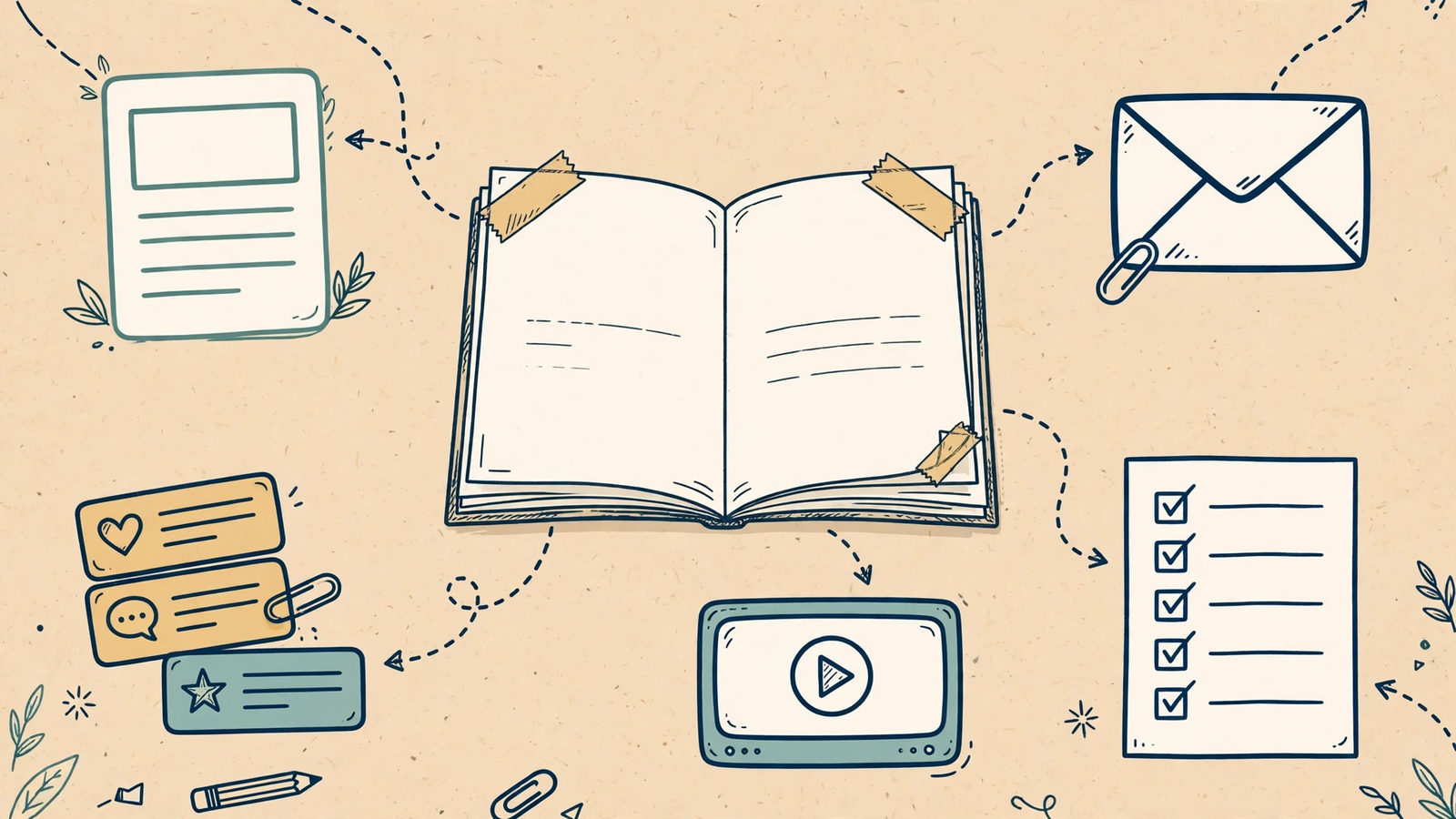
Last month I wrote one solid AI-assisted draft about fixing sleep, and then I watched it sit there. One article, one audience, one chance to be found. A week later I turned that same draft into a blog post, an email, a set of social posts, a short video script, and a one-page checklist — and the checklist alone brought in more new readers than the original article did. Same ideas, five doors in.
That’s the trick nobody tells you about AI drafts: their real value isn’t the article. It’s the raw material. One good draft contains enough thinking for a week of content, provided you stop treating each format as a copy-and-paste job. Every format has its own job, its own length, and its own reader. Repurposing means re-shaping the idea for each one — not shrinking the same paragraph five times.
Here’s the routine I use, starting from a single draft I’m already happy with.
Start with a draft worth multiplying
Not every draft deserves five formats. Before I repurpose anything, I ask three questions. Does it have one clear idea a stranger could repeat back to me? Does it contain at least three concrete points, not just vibes? And would I still stand behind it next week? If the answer to any of those is no, I fix the draft first. Multiplying a weak draft just gives you five weak pieces instead of one.
I also pick the core idea before I touch any format. In that sleep draft, the core idea was one sentence: “Your evening routine matters more than your morning alarm.” Everything else — the tips, the examples, the checklist — hung off that sentence. When each format carries the same core idea in different clothes, the whole set feels coherent instead of scattered. When each format tries to carry everything, all five feel thin.
One practical note: do your human edit before you repurpose, not after. Fix the voice, cut the filler, check the facts once, in the master draft. Then every format inherits the good version. Edit after repurposing and you’ll be fixing the same sentence five times in five places, which is exactly the kind of busywork AI was supposed to save you from.
Format one: the blog post, the home base
The blog post is the full version — the one every other format points back to. This is where the examples live, the nuance, the “here’s why this works” reasoning. Aim for the complete argument, not the longest version: if a paragraph doesn’t serve the core idea, it doesn’t earn its place here either.
I structure it the way I structure every guide: a problem the reader recognises, the core idea stated plainly, three or four concrete points with examples, and a short honest section about what won’t work. That structure matters because the other formats are all cut from it. The email takes the problem and one point. The social posts take the individual points. The checklist takes the actions. If the blog post is a shapeless ramble, the spin-offs will be too.
Format two: the email, one idea and one ask
An email is not a short blog post. It’s a letter to one person, and it should do exactly one thing. I take the single most useful point from the draft — the one a reader could use today — and build the email around it.
The shape I use is simple: one relatable opening line, the point in plain language, one short example, and one ask. The ask might be “read the full guide,” or “reply and tell me your evening routine,” or “download the checklist below.” Never all three. An email with three asks gets zero clicks; an email with one ask gets the click it deserves.
I also rewrite the opening for email. Blog openings set a scene; email openings start mid-conversation, like you’re continuing something the reader already cares about. “You told me you keep snoozing through your alarm” beats “Sleep is important for productivity” every time, because one of those sounds like a person and the other sounds like a textbook.
Format three: social posts, one point per post
This is where most repurposing goes wrong. People paste a paragraph into a social post, watch it flop, and conclude their content doesn’t work on social. It does — it just doesn’t work in paragraph form.
Each social post gets exactly one point from the draft, rewritten as something a scroller can grasp in three seconds. A tip becomes a short list. A mistake becomes a “stop doing this” hook. A surprising example becomes the whole post, with the lesson as the last line. I usually get four or five posts out of one draft this way, and I space them across the week instead of dumping them all on Monday.
The rule I hold myself to: if a post needs the blog post to make sense, it’s not finished. Social posts should stand alone and make the reader curious, not confused. Curiosity sends people to the blog post. Confusion sends them scrolling past.
Format four: the short video script, spoken not written
Video punishes written language. A sentence that reads beautifully on the page sounds stiff out loud, and the first thing I do when adapting a draft for video is read it aloud and cross out anything I wouldn’t actually say to a friend.
A short video script needs three beats and nothing else: the hook in the first five seconds (“Your alarm isn’t the problem — your evening is”), one point explained with a concrete example, and a closing line that tells the viewer what to do next. That’s it. If your draft has four points, that’s four videos, not one video with four points crammed in. Viewers remember one idea from a short video. Give them the best one.
I also write stage directions into the script, briefly: what shows on screen while I talk, where the example appears, when the text overlay lands. Nothing fancy — a line in brackets is enough. The script isn’t just words; it’s a plan for what the viewer sees, and a plan made now saves an hour of confused editing later.
Format five: the checklist, the keeper
The checklist is the format people save, print, and actually use — which makes it the most valuable spin-off of the lot. Take every action from the draft, strip out the explanation, and turn what’s left into steps in order.
Good checklist rules: each item starts with a verb, each item is one action (“Put your phone on charge outside the bedroom”), and the whole list fits on one page. If an item needs a paragraph of explanation, it isn’t a checklist item — it’s a blog section wearing a costume. Cut it or simplify it.
Put the checklist at the end of the blog post as a download or a boxed summary, and link it from the email too. It gives readers a reason to come back to the article, and it gives you something genuinely useful to offer instead of another “subscribe for more content” plea.
A quick checklist
- Master draft human-edited, fact-checked, and built around one clear core idea
- Blog post published as the home base, with the full argument and examples
- Email written around one point and one ask, opening rewritten for inbox tone
- Social posts drafted one point per post, each standing alone
- Video script written for speaking, one point per video, hook in five seconds
- Checklist distilled to verb-first actions that fit on one page
- Every format links back to the blog post — and none of them is a copy-paste
The honest truth
Repurposing is not free content. Each format takes real rewriting, and anyone selling you “one click, five formats” is selling you five copies of the same mediocre paragraph. The saving isn’t in the writing — it’s in the thinking. You thought once, carefully, about something worth saying. That’s the expensive part. The formats are just five honest ways of saying it to five different kinds of readers.
Done that way, one draft stops being one article. It becomes a small system: the blog post for search, the email for your existing readers, the social posts for strangers, the video for watchers, and the checklist for the people who actually want to do the thing. Same idea, five doors in. That’s a much better return on one good draft than a single post gathering dust.
Frequently Asked Questions
Isn’t repurposing the same idea five times just spam?
No — spam is the same text pasted five times. Repurposing is the same idea re-shaped for a different format and a different reader. The blog post argues, the email talks to one person, the social post hooks a scroller, the video shows, the checklist instructs. If each version is genuinely rewritten for its job, readers experience it as helpful, not repetitive.
Should I publish all five formats on the same day?
I wouldn’t. Publish the blog post first, then space the spin-offs across the week: email the next day, social posts spread over several days, video when it’s edited, checklist linked from the post from day one. Staggering gives each format its own moment and gives you five chances to reach someone instead of one noisy day.
What if my draft only has one good point?
Then make one good blog post and one good social post, and stop there. Not every draft deserves five formats — forcing five spin-offs out of a thin idea is how you end up with filler. The five-format routine is a menu, not a quota. Use the formats the idea can honestly support.
Do I need AI tools to repurpose, or can I do it by hand?
You can absolutely do it by hand, and for a first attempt I’d recommend it — you’ll learn what each format actually needs. AI tools can speed up the mechanical parts, like drafting social variations or condensing the checklist, but the decisions (which point, which hook, which ask) are yours. Hand those to a tool and you get five formats that all sound like the tool.
Continue your workflow
Was this guide helpful?
Tell us what needs improving →
Your selection stays on this page. To send feedback to the publication, use our contact form.
Published 29 October 2026 · Text Craft Pro · AI-assisted educational writing. Editorial policy · Suggest a correction