Planning
How I Plan a Week of Content in One Sitting
One focused sitting on Sunday saves me five mornings of staring at a blank page. Here’s the 90-minute routine I use to plan a whole week of content — themes, titles, and outlines — without burning out by Tuesday.
 Written by Daniel Carter
Daniel Carter writes and edits practical guides on writing, editing, and publishing at Text Craft Pro, based on hands-on testing and documented examples.
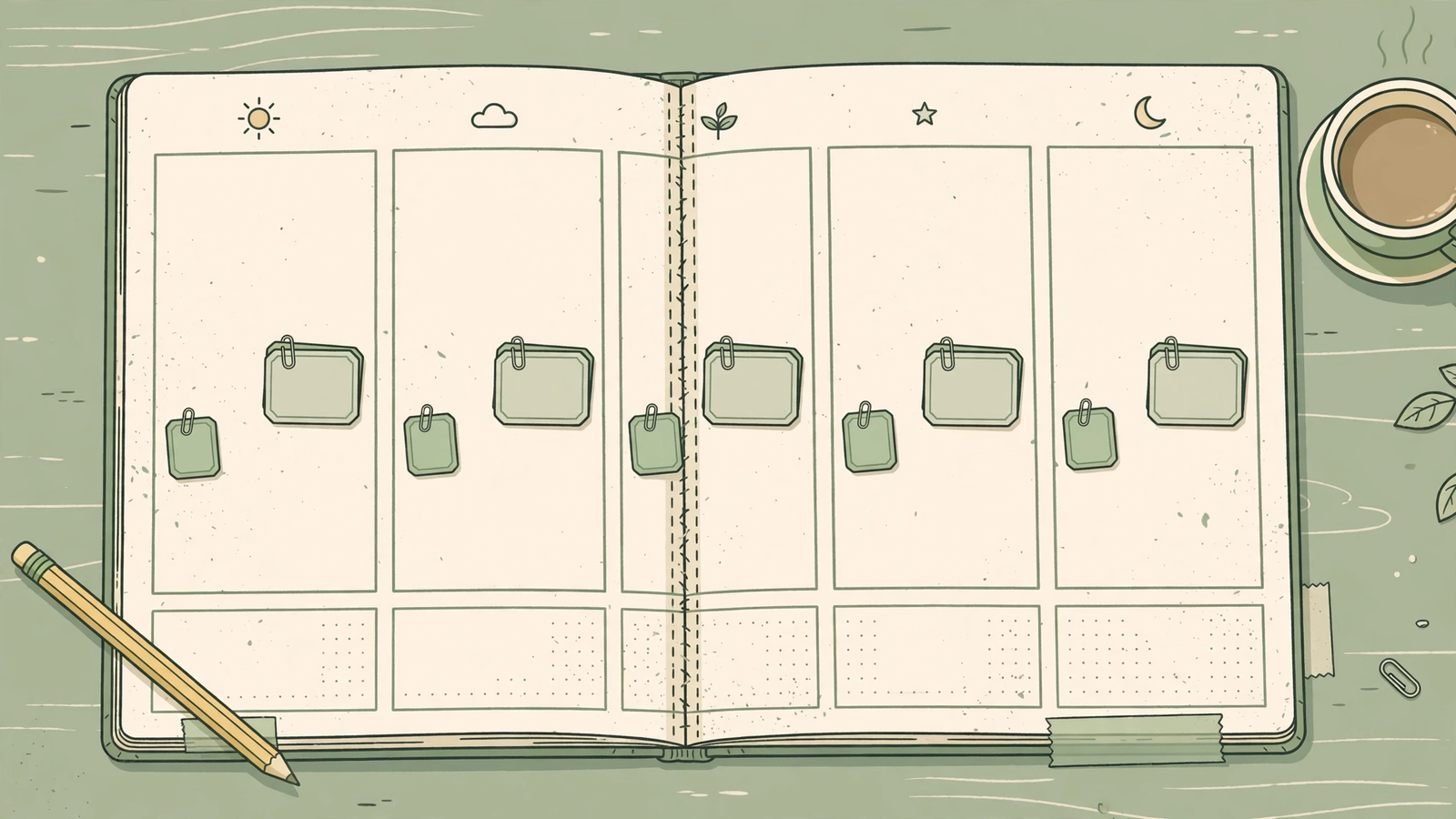
Sunday afternoon, a blank document, and ninety minutes. That’s the whole planning system I use for a week of content — no apps, no elaborate boards, just a sitting where I decide everything in advance so the weekdays are for writing, not deciding.
The plan I walk away with is deliberately thin: one theme, five titles, one angle per piece, and three lines of outline each. Thin is the point. A plan that’s too detailed becomes a second draft; a plan that’s too vague is just a wish list. Here’s how the ninety minutes break down.
1. Why I stopped planning day by day
For months, my mornings went like this: coffee, open laptop, stare at a blank document, and ask myself what I should write today. Some days the answer came fast. Most days it didn’t, and by the time I’d decided, half my writing hour was gone.
The problem wasn’t a lack of ideas. It was a lack of decisions made in advance. Every morning I was paying a decision tax — what topic, what angle, what format — before I’d written a single useful sentence. Planning a week in one sitting moves all of those decisions to a single slot, when I’m fresh and not under deadline pressure. Then, during the week, I just execute.
I do this on Sunday afternoon, and it takes about 90 minutes. Not a whole day, not a colour-coded spreadsheet project — 90 minutes, a notebook or a blank document, and one rule: by the end of the sitting, every weekday has a title, an angle, and a three-line outline. Nothing is left as “figure it out later,” because later is exactly where good intentions go to die.
2. Start with one theme, not five topics
The first mistake I made was planning five unrelated posts. Monday on prompts, Tuesday on email, Wednesday on résumés — each one a cold start. Every morning I had to rebuild my thinking from scratch, and the week felt scattered.
Now I pick one theme for the week, and every piece hangs off it. Say the theme is “editing AI drafts.” Monday’s post is the checklist, Tuesday’s is a before-and-after edit, Wednesday’s is the common mistakes piece, and so on. The research overlaps, the examples carry over, and by Wednesday I’m writing faster because I’ve already been thinking about the same territory for two days.
A theme also makes the week feel like something, not just five posts. Readers who find Monday’s piece have a reason to come back on Wednesday. And if a theme runs dry by Thursday, that’s useful information too — it tells me the theme was thinner than I thought, and I note it for next time instead of forcing two more posts out of it.
3. Harvest ideas before you assign them
I never start a planning session by staring at a calendar. I start by emptying my head. For ten minutes I write down every half-idea I’ve collected during the week: questions readers asked, sentences I underlined, problems I ran into while editing my own drafts, things I wished someone had explained to me. No judging, no sorting — just a messy list, usually fifteen to twenty items long.
Only then do I pick five. The test is simple: can I state the point of this piece in one sentence, and do I have at least one concrete example for it? If I can’t do both, the idea goes back on the shelf. A vague idea planned for Thursday becomes a painful Thursday. A vague idea left unplanned costs nothing.
This is also where AI earns its keep in my planning. I’ll feed it the messy list and ask what patterns it sees, or what angles I’m missing on a topic I know well. It sometimes spots a grouping I’d missed — three of my stray notes were really one article about voice. But the final pick is always mine. An AI can suggest; it can’t tell which idea I’m actually fired up to write, and that matters more than cleverness.
4. Give every day a title, an angle, and three lines
A plan that says “Monday: blog post about editing” is not a plan. It’s a postponement. For each day I write three things, and I don’t move on until all three exist:
- The title, roughly. Not the final headline — a working title that tells future-me what the piece is about. “How I cut 30% from an AI draft without losing the point” beats “Editing tips.”
- The angle. One sentence on the point of view. Is this a how-to, a mistake I’ve made, a test I ran, an opinion? Two pieces on the same topic with different angles are two different articles; without an angle, they’re the same article twice.
- Three lines of outline. The opening problem, the main point, and the ending or takeaway. Three lines is enough to start writing immediately, and short enough that planning five days doesn’t turn into writing five drafts.
That last part matters. Planning is not drafting. The moment I catch myself writing full paragraphs in the planning session, I stop. A planning session that turns into a writing session produces one finished piece and four vague days — the exact problem I was trying to solve.
5. Batch the boring parts
Some parts of publishing repeat every single time: finding an image, writing the excerpt, picking tags, checking the links. Done one at a time, each takes ten minutes and breaks your flow. Done in a batch, they take half that.
So after the outlines are set, I spend the last fifteen minutes of the sitting on the batchable bits. I note which tool or example each piece will link to, I sketch the image idea for each post in a phrase (“a desk calendar with five marked days”), and I flag any piece that needs a screenshot or a test run during the week. I don’t do the tasks — I just line them up so that when writing time comes, there’s nothing standing between me and the first sentence except the writing itself.
I also leave one slot deliberately empty. Not every week, but most weeks, the fifth slot is a flex day: a reader question, a follow-up to something that landed well, or simply a buffer if a piece runs long. A plan with no slack breaks at the first surprise. A plan with one flex day absorbs it.
6. A quick checklist
- One theme for the week, chosen before any titles
- Ten minutes of idea-harvesting, messy list first, judging second
- Five pieces picked by the one-sentence-plus-one-example test
- Each day: working title, angle in one sentence, three-line outline
- Batchable bits noted (image idea, links, screenshots needed)
- One flex or buffer slot left open
- The plan written somewhere you’ll actually look on Monday morning
The honest truth
Planning a week in one sitting will not make you love writing every day. Some mornings will still be a grind, and some planned pieces will still resist you when you sit down to write them. What planning does is remove the worst kind of friction: the empty-page morning where you don’t even know what you’re supposed to be doing.
It also teaches you something about your own output. After a few weeks of this, you’ll notice patterns — which themes produce five strong pieces and which ones stall at three, which angles you keep returning to, which days of the week you’re actually sharp. That pattern is worth more than any single week’s plan, because it tells you what your real capacity is, not what you wish it were.
Ninety minutes on Sunday. Five mornings that start with a title, an angle, and three lines instead of a blank page. That’s the whole deal, and it’s the closest thing I’ve found to a writing habit that survives contact with a real week.
Frequently Asked Questions
What if I only publish twice a week — does this still work?
Yes, and arguably better. The routine scales down cleanly: pick a theme, harvest ideas, and plan two pieces instead of five. The point isn’t five posts; it’s deciding in advance. Two planned posts beat five improvised ones, and the same title-angle-outline format works at any frequency.
Should I write the full drafts during the planning sitting?
I wouldn’t. Planning and drafting use different muscles, and mixing them usually means you finish one draft and leave the rest of the week vague. Keep the sitting to decisions — titles, angles, outlines — and let drafting have its own slot. If an outline suddenly turns into a paragraph because the idea is hot, write it down and move on, but don’t chase it.
What happens when a planned piece falls apart midweek?
Swap in the flex day, or promote an idea from the harvest list that didn’t make the cut. That’s exactly why the plan is written in pencil, not stone. A plan that can’t survive one bad piece isn’t a plan, it’s a fantasy. The week still works if four of the five pieces ship as planned and the fifth becomes something better.
Can AI tools do the planning for me?
They can do the mechanical half: grouping ideas, suggesting angles, spotting gaps in a week’s theme. What they can’t do is judge which ideas you’re genuinely equipped to write, or which angle carries your actual opinion. Use AI to widen the list, then make the final picks yourself. The picks are the plan.
Continue your workflow
Was this guide helpful?
Tell us what needs improving →
Your selection stays on this page. To send feedback to the publication, use our contact form.
Published 29 October 2026 · Text Craft Pro · AI-assisted educational writing. Editorial policy · Suggest a correction