Editing
AI Proofreading: What It Catches and What It Misses
AI proofreaders are fast, tireless, and wrong in ways you’d never expect. Here’s what they catch, what they miss, and the two-pass routine I use before anything goes live.
 Written by Daniel Carter
Daniel Carter writes and edits practical guides on writing, editing, and publishing at Text Craft Pro, based on hands-on testing and documented examples.
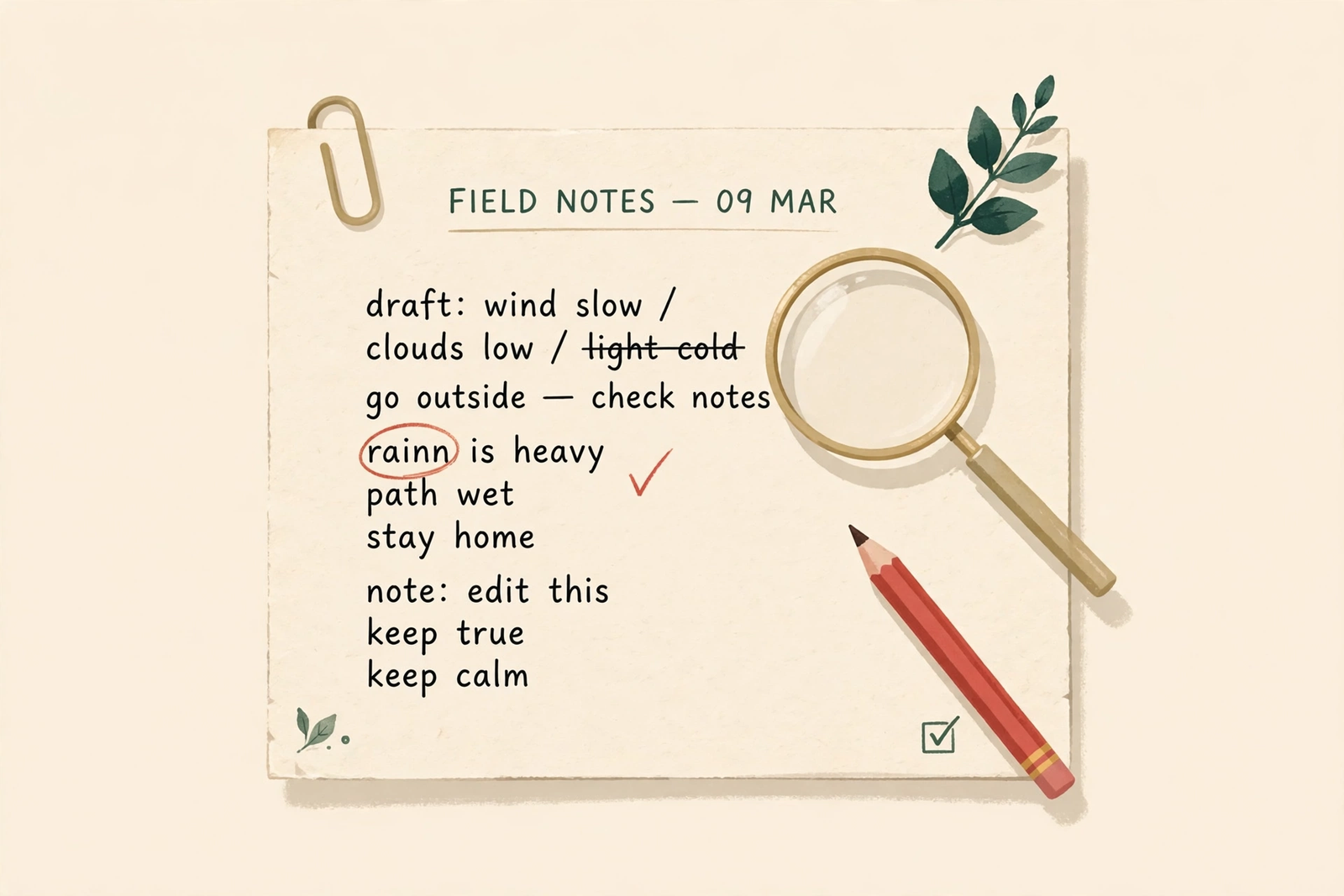
I ran a finished draft through an AI proofreader last month, fixed everything it flagged, and published feeling smug. Then a reader emailed me within the hour: I’d written “public” when I meant “publish” in the second paragraph. The sentence was grammatically perfect. It was also wrong.
That’s AI proofreading in one story. It’s fast, tireless, and genuinely good at a specific set of jobs — and it misses exactly the mistakes that embarrass you most. After a year of running every draft on this site through both AI tools and my own eyes, here’s an honest map of where each one earns its keep.
1. What AI catches that you’ll never see
AI proofreaders are ruthless about the small stuff, and the small stuff is exactly what tired human eyes skip. Typos that spellcheck already gave up on. Doubled words — “the the” — that your brain auto-corrects while reading. A missing comma before a quote. Inconsistent hyphenation: “well-written” in paragraph two, “well written” in paragraph nine.
It also catches things that aren’t strictly errors but are still worth fixing. A sentence that runs seventy words long. The same word used four times in one paragraph. A tense that quietly shifts halfway through a section. I once had an AI tool flag that I’d used “actually” eleven times in a 900-word draft. Eleven. I hadn’t noticed a single one.
This is the part of proofreading where AI genuinely beats a human. It’s not reading for meaning, so it doesn’t get lulled by a good argument the way you do. It scans the surface, and the surface is where most typos live.
2. What it catches — but “fixes” badly
Here’s where the trouble starts. AI proofreaders don’t just find errors; they suggest rewrites, and their rewrites aim for the average sentence. Give one a line with any personality — a fragment for emphasis, a sentence that starts with “And,” a deliberate bit of repetition — and it will offer to “improve” it into something flatter.
I keep a list of fixes I’ve had to undo:
- A punchy two-word sentence — “Not yet.” — expanded into “This has not yet been accomplished.”
- A conversational opener — “Here’s the thing” — replaced with “It is important to note that.”
- A deliberate repeat for rhythm — three sentences starting with “I” — rewritten so no two sentences share a structure.
None of those suggestions were wrong, grammatically. All of them made the writing worse. The rule I use now: accept AI’s corrections to spelling, punctuation, and obvious grammar. Reject its style suggestions by default, and only take one when you can say out loud why the new version is better.
3. What it misses entirely
This is the important list, because these are the mistakes that cost you credibility.
Wrong words that are still real words. “Public” instead of “publish.” “Stationary” instead of “stationery.” “Affect” instead of “effect.” AI tools have improved at this, but they still miss plenty — especially when the wrong word makes a grammatical sentence. A spellchecker can’t help you here either; the word is spelled correctly. Only a reader who knows what you meant can catch it, and the AI doesn’t know what you meant.
Facts. AI proofreaders don’t check facts. They’ll happily correct the grammar of a sentence that claims the wrong year, the wrong name, or the wrong statistic. Worse, some tools will “fix” an unusual-but-correct fact into a common-but-wrong one — I’ve seen a tool suggest changing a correctly spelled niche term into a more common word that meant something else entirely.
Logic and flow. A paragraph can be perfectly proofread and still not make sense. The argument can jump from A to C without B. The conclusion can contradict the introduction. AI proofreading looks at sentences; it doesn’t follow arguments. I once published a draft where two adjacent paragraphs said opposite things about the same tool. Every comma was in place.
Tone. An AI proofreader won’t tell you that your friendly how-to guide suddenly sounds like a legal disclaimer in section three. It won’t notice that you were warm and direct for five paragraphs and then went stiff and corporate. Tone drift is invisible to a tool that scores sentences one at a time.
4. The two-pass routine I actually use
Once I understood the split — AI for the surface, me for the meaning — proofreading got both faster and better. Here’s the routine, start to finish:
Pass one: AI, with a narrow brief. I paste the draft in and ask for one thing only: spelling, punctuation, and grammar errors. I don’t ask it to improve the writing, tighten the prose, or suggest alternatives. A narrow brief gets a narrow, useful answer. I accept the mechanical fixes and ignore the style suggestions.
Pass two: me, reading aloud. This is the pass that catches everything on the miss list. I read the whole draft out loud — slowly, standing up if I can. Reading aloud forces you to hear the words as your reader will, and your ear catches what your eye forgives: the wrong word that still scans, the sentence that contradicts the one before it, the paragraph where the tone suddenly changes. It takes about five minutes for a 1,000-word draft. It is the single highest-value proofreading habit I have.
Pass three (for anything important): fresh eyes. If the piece matters — it’s going to a client, it’s the flagship guide, it’s something I’ll be judged on — I let it sit overnight and read it once more in the morning. A night of sleep resets your eyes the way no tool can. I catch at least one real error in that morning read almost every time.
5. A word about “AI-proofed” claims
You’ll see tools advertised as proofreaders that promise error-free text, and writers who say they “ran it through AI” as if that settled the question. It doesn’t. An AI proofread is a first pass, not a finished job — the same way an AI draft is a first draft, not a finished article.
The honest claim is this: AI caught the typos, and then a human read it. If you’re publishing anything under your name, the human read is the part that protects your reputation. The typos are embarrassing for a day. The wrong fact in a clean sentence follows you around.
The honest truth
AI proofreading is genuinely useful, and I use it on everything I publish — including this article. It catches the doubled words, the missing commas, the “actually” I used eleven times. That’s real work, and it saves real time.
But it’s a surface tool, and the mistakes that matter most live below the surface. Wrong words that spell fine. Facts that are wrong in a grammatical sentence. Arguments that don’t hold together. Tone that drifts. No proofreader — AI or human — catches everything, but the combination of a narrow AI pass and a slow human read aloud catches far more than either one alone.
So run the draft through the tool. Fix the typos. Then read it out loud yourself, like a reader who trusts you. That’s the part no tool can do for you.
Frequently Asked Questions
Can I rely on AI alone to proofread my writing?
No — not for anything you’ll publish under your name. AI is excellent at spelling, punctuation, and grammar, but it misses wrong words that are still real words, factual errors, and logical gaps. Use it as a first pass, then do a human read — out loud is best — before publishing.
What’s the difference between AI proofreading and AI editing?
Proofreading checks the surface: spelling, punctuation, grammar, consistency. Editing works on meaning: structure, clarity, argument, tone. AI tools are strong at the first and weak at the second. Don’t confuse a clean proofread with a finished edit.
Why does AI “fix” sentences that weren’t broken?
Because most proofreading tools are tuned to prefer the most common, most formal version of a sentence. Fragments, conversational openers, and deliberate repetition all read as errors to a tool that scores sentences against an average. Accept the mechanical corrections; reject style suggestions unless you can say why the new version is better.
What’s the fastest reliable proofreading routine?
Three passes: first, an AI tool with a narrow brief — spelling, punctuation, grammar only. Second, read the whole draft out loud yourself; your ear catches wrong words, contradictions, and tone drift that your eye skips. Third, for anything important, let it sit overnight and read it once more in the morning.
Continue your workflow
Was this guide helpful?
Tell us what needs improving →
Your selection stays on this page. To send feedback to the publication, use our contact form.
Published 9 November 2026 · Text Craft Pro · AI-assisted educational writing. Editorial policy · Suggest a correction