Editing
How to Collaborate with AI on Long-Form Content
A 3,000-word guide is where AI stops being a helpful shortcut and starts being a liability. Here is the working arrangement I use on every long piece: the model does the volume — research summaries, outlines, first-pass sections — while I keep the decisions.
 Written by Daniel Carter
Daniel Carter writes and edits practical guides on writing, editing, and publishing at Text Craft Pro, based on hands-on testing and documented examples.
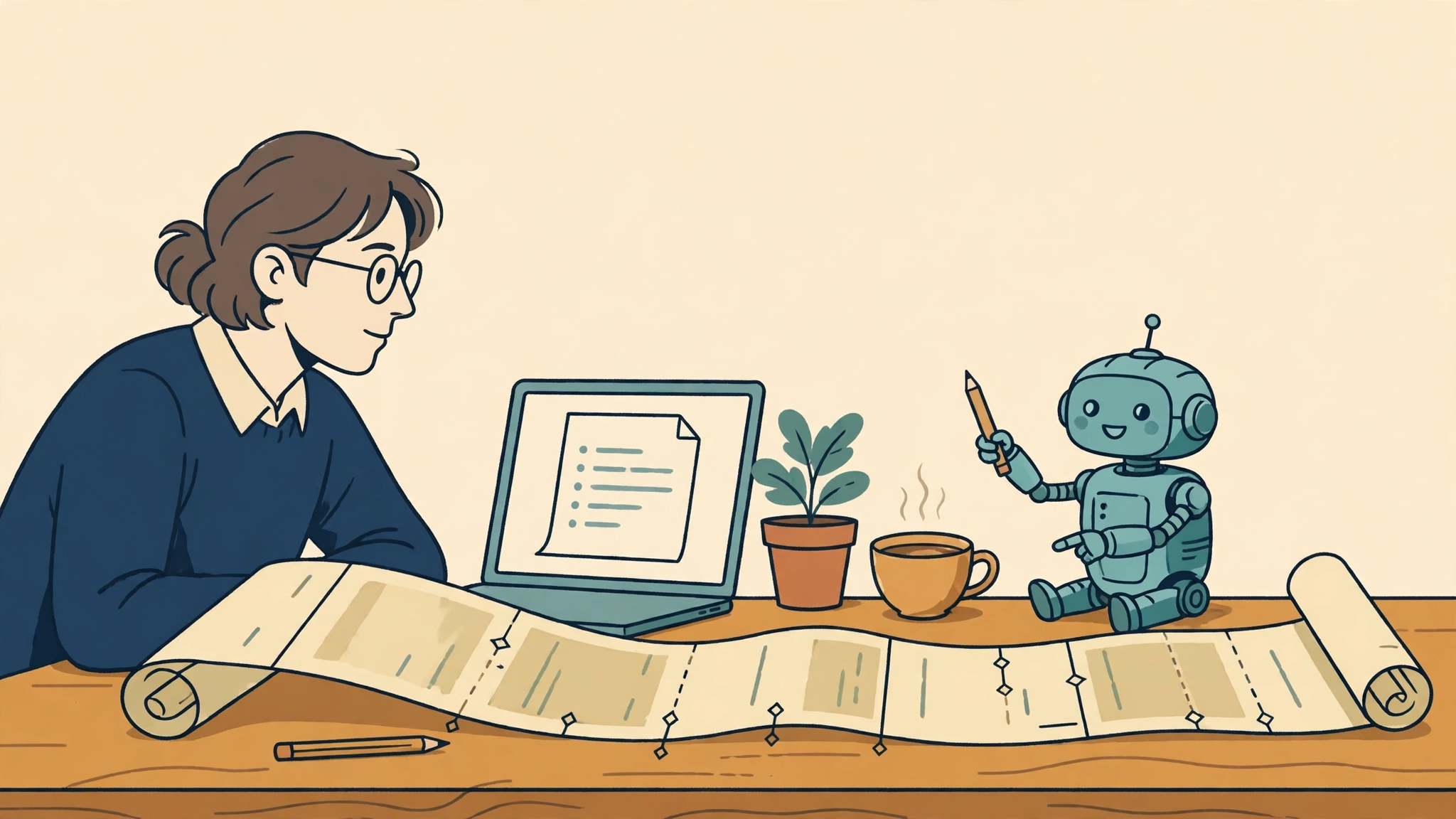
A 3,000-word guide is where AI stops being a helpful shortcut and starts being a liability. Short posts forgive a lot — a flat paragraph here, a generic example there, nobody notices. Long-form doesn’t forgive anything. The reader has to stay with you for twenty minutes, and every paragraph that sounds like it was written by a committee of one gives them a reason to leave.
I’ve written long guides with AI in the loop for over a year now, and the ones that work share one thing: the AI never owns the argument. It does the heavy lifting — research summaries, outlines, first-pass sections — while I keep the decisions. Here’s the working arrangement I’ve settled on.
1. Start with a brief the AI can’t ignore
Long-form collaboration fails at the brief, not at the draft. If you ask for “a guide about X,” you’ll get a generic structure that could belong to anyone. Before I touch the AI, I write a one-page brief: who the reader is, what they can already do, the one thing they should be able to do after reading, three points I refuse to compromise on, and two examples from my own work that must appear somewhere.
The brief is the contract. When a section drifts — and it will — I point at the brief instead of rewriting from scratch. “This section doesn’t serve the reader I described” is a fixable problem. “This feels off” is not.
2. Outline together, write apart
I used to ask the AI to draft whole sections in sequence. The result was a guide that read like five different articles stapled together, because each section was written without memory of the last. Now the outline is the only thing we build together, and I treat it like a real editorial meeting.
I ask for three outline options, pick the bones of the best one, then rearrange it myself. The outline has to answer one question per section: what does the reader learn here that they didn’t know in the previous section? If a section can’t answer that, it gets cut before a single sentence is written. Only then do we start drafting — one section at a time, each with its own brief pulled from the outline.
3. Draft one section at a time, and read each one before moving on
This is the discipline that saves the most time. Long-form AI drafts compound errors: a weak definition in section two becomes a confused example in section five, and by section eight you’re editing a stranger’s argument. So I never let the AI write two sections back to back without me reading the first.
My loop is simple. Draft a section. Read it immediately, out loud if I can. Fix the argument, cut the filler, add the one specific detail only I know. Then — and only then — hand the next section’s brief to the AI, with a short note: “Section two now says this. Build on it.” The draft stays coherent because I stay in the loop at every joint.
4. Give the AI jobs it is actually good at
The fastest way to ruin a collaboration is to ask the AI to do your job. It’s a bad strategist and a mediocre writer, but it’s a tireless research assistant and a ruthless first reader. I use it for four things and almost nothing else: summarising source material I feed it, turning my rough notes into a readable first pass, generating ten variations of a subheading so I can pick the sharpest, and checking a finished section for gaps — “what would a sceptical reader ask here that I haven’t answered?”
Notice what isn’t on that list: deciding the argument, choosing the examples, setting the tone. Those are the decisions that make a guide yours. Outsource the labour, never the judgement.
5. Keep a living style sheet for the project
Every long piece drifts. By word 2,000 the AI has forgotten that I write “you” instead of “one,” that I prefer short paragraphs, that I never open a section with “In today’s world.” So I keep a short style sheet — ten lines, pasted into every section brief. Things like: sentences under twenty words where possible, one concrete example per section, no “delve” or “tapestry,” headings that promise something specific.
It sounds fussy. It saves hours. The style sheet is what keeps section nine sounding like it was written by the same person as section one, and it means the final edit is about ideas, not about scrubbing the same tics out of every paragraph for the tenth time.
6. Edit in passes, not in one marathon
A long draft edited in a single sitting gets a tired editor, and tired editors approve mediocre sentences. I run three passes on different days when I can: pass one for structure — does the argument hold, does each section earn its place; pass two for voice — read it aloud, cut the filler, rescue the sentences only I would write; pass three for facts and details — every claim checked, every example verified, every link clicked.
Between passes, the AI gets one job: read the draft and tell me where a reader would get lost or bored. It is surprisingly good at that, because it has no ego about the text. I take its notes, decide which ones are right, and do the rewriting myself.
The honest truth
Long-form content is where the difference between “written with AI” and “written by AI” becomes visible. A reader will forgive a generic sentence in a 400-word post. They won’t forgive a generic argument across 3,000 words — they’ll just leave, and they won’t come back. The collaboration works when the AI does the volume and you do the thinking. The moment you flip that, the guide stops being yours, and readers can tell, even if they can’t say why.
Frequently Asked Questions
How long should each AI-drafted section be before I edit it?
Short enough to read in one sitting — roughly 300 to 500 words. Longer than that and you’ll skim instead of edit, which is how weak arguments survive. If a section needs to be longer, split it at a natural break and treat each half as its own draft.
Should I let the AI write the introduction first or last?
Last. An introduction written before the argument exists is a promise the rest of the piece may not keep. Write the sections first, see what the guide actually argues, then write — or have the AI draft — an introduction that matches the finished piece, not the outline you started with.
How do I stop the AI repeating itself across sections?
Give each section brief a one-line summary of what the previous sections already covered, and tell it explicitly what not to repeat. Repetition in long-form drafts usually means the AI doesn’t know what came before, and a short “already covered” note fixes most of it.
Is it cheating to use AI on a long guide?
No — as long as you’re honest about it and the thinking is yours. Readers don’t care whether a first draft came from a keyboard or a model; they care whether the argument is sound, the examples are real, and the advice works. If you did the research, made the decisions, and rewrote the weak parts, it’s your work.
Continue your workflow
Was this guide helpful?
Tell us what needs improving →
Your selection stays on this page. To send feedback to the publication, use our contact form.
Published 5 November 2026 · Text Craft Pro · AI-assisted educational writing. Editorial policy · Suggest a correction